The year 2026 is not merely a continuation of a typical business cycle. It represents a transitional phase toward a new global order marked by deep geopolitical fragmentation. Amid this global power shift, Indonesia can no longer rely on passive resilience. The nation must execute a transformative leap to break free from the 5% growth trap and pursue an ambition of 6–8% growth by strengthening domestic fundamentals and ensuring policy certainty.
At present, the global economy is in a critical transition phase, characterized by slower projected growth driven by tight monetary policies and trade fragmentation. A deep understanding of these external dynamics is no longer optional — it is essential for safeguarding domestic economic sovereignty. We are entering an era of “The Great Tension,” in which market stability is shaped not only by economic fundamentals but also by increasingly inward‑looking geopolitical shifts. The continuity of Indonesia’s national development agenda under the “Asta Cita” framework becomes a crucial strategic anchor, providing clear medium‑term policy direction amid these external storms.
Global Economic Growth Projections
Global economic growth in 2026 is projected to slow compared with previous periods. This outlook is influenced by softening global demand, China’s structural economic deceleration, and trade fragmentation driven by geopolitical rivalry between major powers such as the United States and China. These conditions create a more challenging external environment for emerging economies, including Indonesia.
Although global inflation has begun to stabilize, the decline in global interest rates has not fully restored risk appetite. As a result, financial‑market volatility remains a factor that Indonesian businesses must consider.
This dynamic is further compounded by the “Trump Effect 2.0,” referring to the escalation of U.S. protectionist policies, which has triggered heightened volatility in global financial markets. According to the latest data, the global Trade Policy Uncertainty Index, or the World Uncertainty Index, reached 106.862 in Q3 2025, prompting increased global risk aversion and driving capital outflows from emerging markets. These outflows have exerted systemic pressure on the Indonesian rupiah and raised the cost of external financing.
Projected global GDP growth for 2026:
- Global GDP: 3.1% (down from 3.2% in 2025)
- Advanced Economies: 1.6%
- Asia Pacific: 4.2% (slightly lower than 4.5% in 2025)
Persistent external pressures demand a sharper evaluation of the effectiveness of Indonesia’s domestic macro targets to avoid further erosion of household welfare.
Evaluation of 2025 Macroeconomic Targets
Indonesia’s economic growth in 2025 reached 5.04%, slightly below the government’s target of 5.2%, highlighting that the engines of domestic growth have not yet accelerated optimally. The depreciation of the rupiah — averaging Rp16,413 per USD compared with the assumed Rp16,000 — has increased the burden on the manufacturing sector through higher import costs for raw materials and rising interest expenses on foreign debt.
This slowdown is reinforced by the underperformance of the oil and gas sector, which continues to operate below capacity.
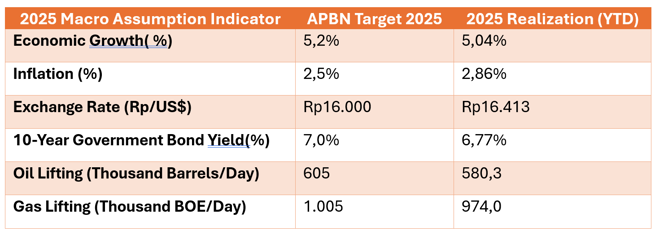
The gap between assumptions and outcomes is not merely technocratic; the consequences are deeply human. The mismatch in exchange rate and inflation assumptions directly erodes household purchasing power, particularly among lower‑income groups already facing economic vulnerability.
Indonesia’s Growth Outlook
The 2026 economic projection is prepared using a prudence‑based approach, given the still‑elevated risks of global shock transmission. The central priority is to generate growth that not only expands numerically but is also inclusive and capable of absorbing a higher‑quality workforce.
Within an uncertain global environment, Indonesia is expected to maintain growth at around five percent. However, this figure reflects fragile stability rather than acceleration. Growth continues to be supported primarily by domestic consumption, while investment has yet to fully recover. The manufacturing sector — which should function as the nation’s economic engine — continues to lose momentum and is shifting toward lower‑value‑added segments. For this reason, 2026 becomes a pivotal year in determining whether Indonesia can transition toward a more productive growth structure or remain dependent on traditional sources such as consumption and commodities.
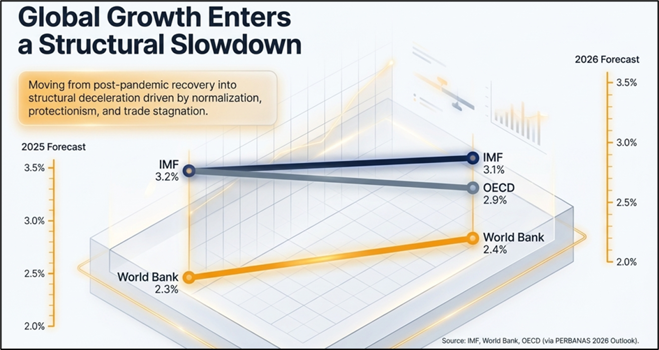
International institutions project global growth to hover between 2.4% and 3.1%, driven by three key factors:
- Easing global interest rates,
- Geopolitical rivalry and trade fragmentation undermining confidence,
- China’s structural slowdown reducing demand for commodities and manufactured goods.
Meanwhile, the global financial system remains heavily anchored to U.S. dollar–denominated markets, making emerging economies highly susceptible to sudden shocks originating from global financial centers.
For ASEAN, supply‑chain repositioning triggered by U.S.–China tensions presents investment opportunities. However, the region’s upstream dependence on China limits the potential gains and calls for stronger localization strategies.
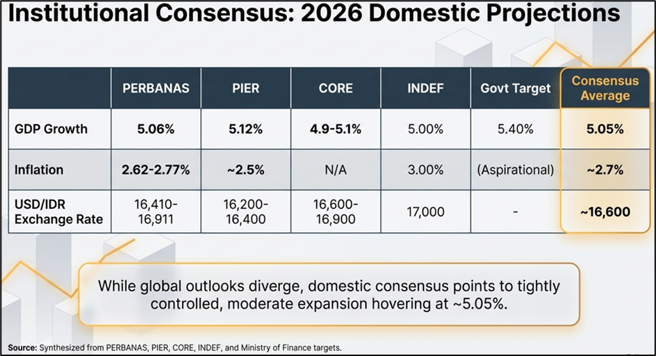
Indonesia is projected to grow at around five percent in 2026. The government targets 5.4%, while institutions such as the IMF, World Bank, ADB, and OECD estimate 5.0–5.1%. Despite this target, the government must address the structural constraint of a high Incremental Capital Output Ratio (ICOR). Excessive economic overhead — driven by bureaucratic inefficiencies — prevents incoming investment from translating into optimal output growth. Without decisive deregulation, the ambition of achieving 6–8% growth will remain elusive.
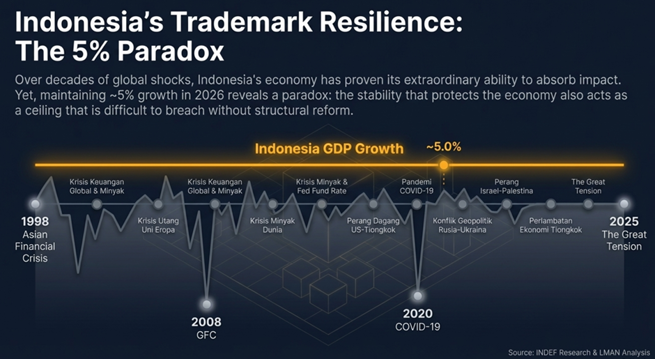
For more than two decades, Indonesia has demonstrated a defining economic pattern: the ability to maintain roughly 5% growth despite global crises. This reveals a paradox — strong resilience but also a visible growth ceiling.
Across events including the 1998 Asian Financial Crisis, the 2008 Global Financial Crisis, the European debt crisis, oil price spikes, the U.S.–China trade war, the COVID‑19 pandemic, the Russia–Ukraine conflict, and China’s economic slowdown, Indonesia’s GDP trajectory has shown temporary declines followed by rebounds toward the five‑percent range.
Notably, in 2025–2026, the world enters “The Great Tension,” defined by simultaneous pressures:
- China’s structural slowdown,
- Fragmented global supply chains,
- U.S. tariff pressures on multiple countries,
- Commodity price normalization,
- Large fiscal needs for social programs,
- Uncertain timing of global interest‑rate cuts.
Yet Indonesia’s growth projection for 2026 remains around five percent, reinforcing the long‑standing pattern: even amid heightened global tension, the 5% level remains Indonesia’s gravitational center of growth.
Unless Indonesia carries out major reforms in productivity, human‑capital quality, bureaucratic efficiency, and industrial innovation, the economy will continue on a path of stable but flat growth.
Key Drivers of Growth
Household consumption remains Indonesia’s primary growth driver, though purchasing power has not fully recovered due to pressures on real wages. Real wage data in major labor‑absorbing sectors — manufacturing, trade, and construction — still shows contraction, while reports of layoffs in labor‑intensive industries indicate that domestic demand remains weak. Consumer credit growth slowed throughout 2025, signaling that households remain cautious and prioritize saving.
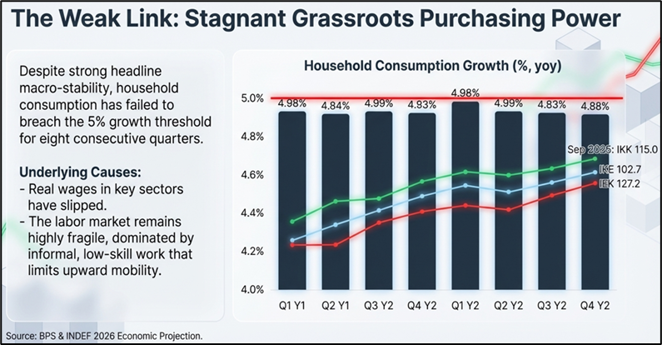
Household consumption accounts for more than half of Indonesia’s GDP, but for the past eight quarters, consumption growth has consistently remained below five percent. According to CRIF Indonesia, weakened purchasing power is reflected in the declining Consumer Confidence Index and the slowdown in VAT and luxury‑goods tax revenues.
On the labor market side, real wages have not increased and have even declined in several key sectors. Rising living costs have encouraged households to tighten spending, focus on essentials, and reduce purchases of durable goods. The slowdown in consumer credit further underscores households’ caution in taking on new obligations. This means consumption can no longer be viewed as an automatic growth driver; it requires stronger and more stable purchasing power to drive the economy effectively.
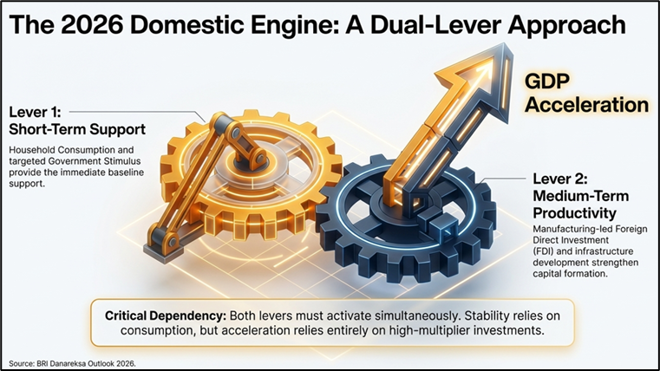
On the investment side, domestic investment has remained relatively stable, but foreign direct investment shows signs of slowing due to heightened risk perception, regulatory changes, and weakening global demand. International trade faces challenges from falling commodity prices and the rise of tariff and non‑tariff barriers in major export markets. As these traditional pillars weaken, improvements in productivity and policy effectiveness will increasingly determine the next phase of Indonesia’s growth.
Investment remains a component that has yet to show meaningful acceleration. Domestic Investment (PMDN) remains relatively strong, but Foreign Direct Investment (FDI) has weakened, especially in non‑commodity manufacturing sectors. This indicates that Indonesia’s competitiveness as a global production base is still lagging compared with other ASEAN countries that offer more conducive regulatory environments, stronger infrastructure, and higher labour productivity. Government investment is also limited due to tightening fiscal space, with large allocations directed toward social programs that absorb substantial budgets but provide lower economic multipliers.
However, the gap between strong FDI optimism and cautious domestic investment signals that industry players are waiting for clarity on demand conditions and policy direction before committing to additional capacity expansion.
Trade & External Outlook
On the trade front, Indonesia faces pressure from the full implementation of the United States’ reciprocal tariff policy (ART) in 2026, which reduces the competitiveness of several Indonesian export products. Declining prices of energy commodities such as coal and crude oil further weigh on export earnings. At the same time, imports from China are expected to rise as China diversifies its export markets, creating additional competitive pressure for Indonesia’s labor‑intensive domestic industries. As a result, the trade surplus is expected to remain positive but narrow, thereby reducing its role as a strong buffer for the national economy.
The U.S. Reciprocal Tariff (ART) framework is reshaping global competitive dynamics. Indonesia holds a unique bargaining advantage through the historical document known as the “Board of Peace,” signed between President Prabowo and Donald Trump, in which Trump personally outlined tariff commitments for Indonesia. As a result, Indonesia secured zero percent tariffs for 1,900 tariff lines, having concluded negotiations ahead of the U.S. Supreme Court decision that later revoked a 15% tariff discount for key competitors such as India. This advantageous tariff position presents a strategic opportunity to attract global manufacturing relocation to Indonesia.
Risk Matrix and Strategic Mitigation for 2026
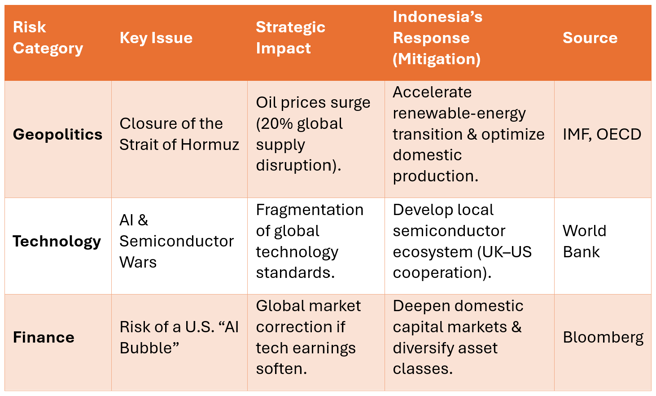
Indonesia’s exports are expected to remain in surplus in 2026, but with shrinking room for expansion. The export structure remains heavily concentrated in commodities such as nickel, coal, palm oil, and steel, making Indonesia vulnerable to global price volatility.
Key external risks include:
- EU’s Carbon Border Adjustment Mechanism (CBAM) fully effective starting 1 January 2026, raising export costs for steel and nickel.
- EU Deforestation Regulation (EUDR) effective December 2026, adding compliance burdens for palm oil (CPO).
- Heavy dependence on China for imports of machinery and electrical equipment (more than 50%), which amplifies risks to the non‑commodity trade balance.
On a positive note, newly concluded trade agreements (IEU‑CEPA, IC‑CEPA, and various Middle East & Africa agreements) are expected to increase GDP by 0.19% and exports by 0.88%.
Inflation & Currency Outlook
Domestic inflation in 2026 is projected to remain within the target of 2.5% ±1%, supported by controlled food and energy prices. Meanwhile, the rupiah is expected to remain relatively stable yet slightly weaker at around Rp16,500 per USD, given narrowing interest‑rate differentials with global benchmarks.
In other words, Indonesia’s overall macroeconomic framework appears orderly, but its foundations remain fragile:
- investment momentum is weakening and remains overly concentrated in commodity‑based sectors,
- Productivity, both labor productivity and total factor productivity, shows a long‑term declining trend.
Persistent risks remain on the supply side, particularly related to global food and energy commodities, where external disruptions can quickly translate into domestic inflationary pressure. At the same time, the rupiah is expected to stay stable yet mildly depreciated as global dynamics and narrowing rate differentials with the United States influence capital flows.
Bank Indonesia’s interventions will continue to play a vital role in managing volatility. However, these interventions must be deployed carefully, as the continued drawdown of foreign‑exchange reserves is not a sustainable long‑term strategy.
Fiscal Policy Direction
The 2026 State Budget (APBN) reflects a significant reorientation toward social and operational spending. Programs such as Makan Bergizi Gratis (Free Nutritious Meals) and Koperasi Desa (Village Cooperatives) absorb considerable fiscal resources, while capital expenditure is reduced.
This shift raises concerns because capital expenditure is crucial for long‑term productivity and economic competitiveness.
Several structural challenges tighten fiscal space:
- Tax‑to‑GDP remains stagnant at 10%,
- Interest payments on government debt continue to rise,
- Transfers to regions (TKD) are reduced by 29%.
These dynamics restrict the government’s room to maneuver and place greater responsibility on the private sector and foreign investment to drive economic growth in 2026.
Industrial Sector Outlook
The industrial sector presents a mixed performance.
- Mineral downstreaming, particularly nickel, continues to support growth in basic‑metal industries.
- Labor‑intensive subsectors such as textiles, garments, and footwear face severe pressure due to rising imports of low‑priced goods and tightening competition.
- Non‑commodity manufacturing remains stagnant due to limited new investment and weak export demand.
Without a clear industrial‑policy direction focused on technology‑driven growth, productivity enhancement, and talent quality, Indonesia runs the risk of premature deindustrialization — a condition where industrial decline occurs before reaching high‑income level.
Sectoral Opportunities & Risks
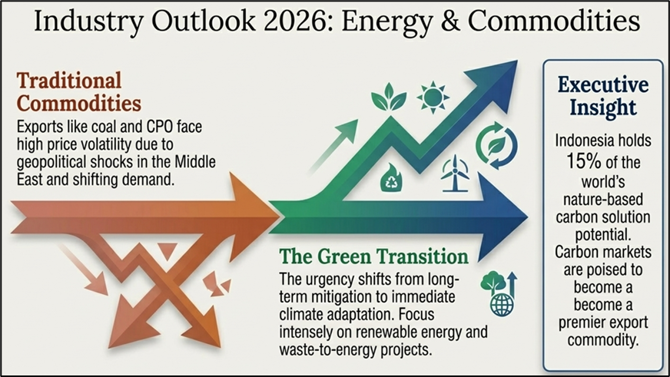
Despite the challenges, several sectors show promising opportunities:
- Agro‑based industries (CPO, coconut oil) benefit from strong prices and stable demand.
- Logistics, warehousing, and industrial estates continue to expand, driven by e‑commerce and supply‑chain diversification.
- Data centers and ICT infrastructure experience rising demand, pushed by digital transformation.
Conversely, several sectors face structural headwinds:
- fossil‑fuel–based industries,
- mall‑based retail,
- high‑rise residential property,
- labor‑intensive manufacturing,
- traditional MSMEs challenged by rising input costs and imported online goods.
Understanding this opportunity‑risk landscape allows businesses to refine strategies and position themselves more competitively.
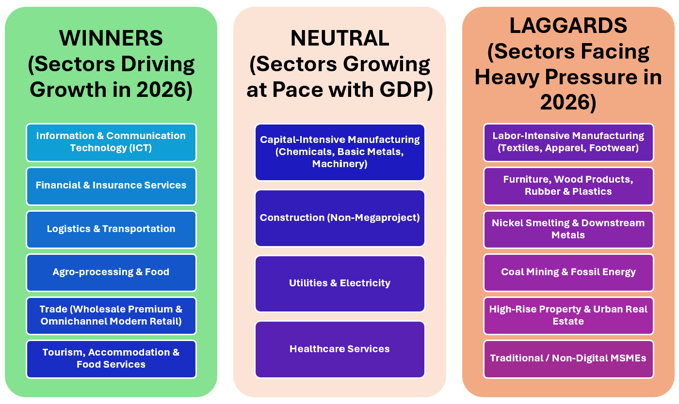
WINNERS - Sectors Driving Growth in 2026
Characteristics: strong demand, positive structural tailwinds, relatively resilient to global slowdown.
1. Information & Communication Technology (ICT)
- Growth consistently outpaces national GDP.
2. Financial & Insurance Services
- Profitability remains solid, NPLs manageable, intermediation improving.
3. Logistics & Transportation
- Fueled by e‑commerce, cold‑chain logistics, and industrial‑estate expansion.
4. Agro‑processing & Food
5. Trade (Wholesale Premium & Omnichannel Modern Retail)
6. Tourism, Accommodation & Food Services
NEUTRAL - Sectors Growing at Pace with GDP
Characteristics: stable growth, not highly impacted, but not major accelerators.
1. Capital‑Intensive Manufacturing (Chemicals, Basic Metals, Machinery)
- Large contributions to investment activity.
2. Construction (Non‑Megaproject)
3. Utilities & Electricity
4. Healthcare Services
LAGGARDS - Sectors Facing Heavy Pressure in 2026
Characteristics: affected by U.S. tariffs, China slowdown, or domestic structural headwinds.
1. Labor‑Intensive Manufacturing (Textiles, Apparel, Footwear)
- Exports to the U.S. hit by 20–40% tariffs; contraction began after August 2025.
2. Furniture, Wood Products, Rubber & Plastics
3. Nickel Smelting & Downstream Metals
4. Coal Mining & Fossil Energy
5. High‑Rise Property & Urban Real Estate
6. Traditional / Non‑Digital MSMEs
Implications for Businesses in 2026
1. Demand Becomes “Dual‑Speed”
Companies must build product portfolios that:
- protect margins through cost efficiencies,
- maintain aspirational products for the premium segment.
Conclusion & Strategic Recommendations
Indonesia’s economic outlook for 2026 is defined by a delicate balance between external volatility and domestic structural challenges. While global growth is slowing and geopolitical fragmentation intensifies, Indonesia’s ability to maintain moderate growth demonstrates resilience — yet also exposes its structural limitations.
To shift from stability to acceleration, Indonesia must:
- boost productivity and workforce capabilities,
- streamline bureaucratic processes,
- advance industrial innovation,
- strengthen investment competitiveness,
- and ensure policy predictability.
For businesses, 2026 is a year to prioritize efficiency, upgrade human‑capital quality, and diversify both supply chains and market exposure. Investment should focus on high‑potential sectors such as logistics, digital services, technology, and agro‑based down streaming.
For policymakers, strong coordination between government and the private sector will be essential. With effective policy support, Indonesia can move beyond a 5% growth ceiling and capitalize on global transitions to build a more productive, inclusive, and resilient economy.