Executive summary
The global semiconductor industry is entering a structurally driven growth phase, expanding from approximately USD 530 billion in 2023 to a projected near USD 1 trillion by 2026, fueled primarily by the rapid adoption of AI, hyperscale data centers, and increasing digitalization across industries. Despite strong growth, the industry remains highly concentrated and capital-intensive, with significant barriers to entry, strong supplier power, and rising geopolitical risks. Recent tensions, particularly in the Middle East, have introduced additional pressures through energy price volatility, supply chain disruptions (notably helium), and increasing fragmentation driven by tech nationalism, all of which are reshaping global semiconductor dynamics and cost structures.
For Indonesia, while its current role in the semiconductor value chain remains limited, the country holds strategic potential through its strengths in raw materials and emerging OSAT capabilities. A pragmatic development strategy focusing on back-end manufacturing, leveraging the EV and battery ecosystem, attracting foreign investment, strengthening talent and R&D, and positioning as a neutral supply chain partner can enable gradual integration into the global ecosystem. This approach allows Indonesia to capitalize on global supply chain diversification trends while building a foundation for long-term advancement in higher-value semiconductor segments.
A. Snapshot global semiconductor industry to indonesia domestic market
Over the past three years, the semiconductor industry has undergone a transformation that goes beyond a typical cyclical recovery, evolving into a structurally driven growth phase. In 2023, the market stood at approximately USD 530 billion, reflecting a recovery period following a downturn caused by weakened global electronics demand and post-pandemic inventory adjustments. Entering 2024, the industry rebounded strongly, growing by around 19% to reach USD 630 billion, supported by the return of demand and the early-stage adoption of artificial intelligence (AI). This momentum accelerated significantly in 2025, with the market surging to USD 791.7 billion, marking a 25.6% increase and signaling the onset of an “AI supercycle,” where demand for chips in data centers, machine learning, and high-performance computing expanded rapidly. Looking ahead to 2026, the industry is projected to approach or even surpass the USD 1 trillion milestone, driven by the dominance of AI, the expansion of hyperscale data centers, and the deepening integration of digital technologies across sectors such as automotive, industrials, and telecommunications.
Global Semiconductor Market Size Growth

Sources: Semiconductor Industry Association, WSTS, Gartner, Deloitte
This rapid global expansion presents a dual implication for Indonesia. It creates opportunities to attract investment in downstream segments such as assembly, testing, and supporting materials, while simultaneously highlighting the need to strengthen the domestic ecosystem to move beyond being merely an end market and become an integral part of the global semiconductor supply chain.
B. Key structural drivers and constraints in the global semiconductor industry
1. Core Demand Drivers and Competitive Strengths
This section highlights the fundamental factors underpinning industry growth, including the structural shift in demand toward AI, cloud, and data centers, alongside high barriers to entry and a well-established global ecosystem that reinforces efficiency and market leadership among key players.
2. Structural Limitations and Industry Vulnerabilities
This section outlines the inherent constraints within the industry, particularly its reliance on geographically concentrated production hubs, continued exposure to cyclical demand patterns, and sensitivity to energy supply and critical raw materials.
3. Emerging Growth Opportunities and Expansion Drivers
This section explores key growth avenues, driven by the rapid expansion of AI applications, hyperscale data centers, electric vehicles, and ongoing global efforts to diversify and localize semiconductor supply chains.
4. External Risks and Downside Pressures
This section examines external challenges impacting the industry, including rising geopolitical fragmentation, risks of overcapacity in certain regions, and increasing global cost structures driven by energy and logistics volatility.
C. Competitive landscape and industry dynamics
1. Barriers to Entry and New Market Participation (Low Threat)
Entry into the semiconductor industry remains extremely challenging due to the substantial capital requirements, highly complex technology, and the entrenched dominance of established players, particularly leading foundries. As a result, new entrants face significant structural barriers, making market entry nearly unfeasible without strong government backing or strategic partnerships.
2. Supplier Influence and Upstream Concentration (High Power)
Suppliers, particularly those providing advanced manufacturing equipment and critical materials such as lithography systems and specialty chemicals, hold considerable influence. This is driven by the limited number of global suppliers and the highly specialized nature of their technologies, creating strong dependency across the industry.
3. Buyer Leverage and Demand Concentration (Moderate Power)
Large-scale buyers, including hyperscalers and cloud service providers, possess moderate bargaining power due to their significant purchasing volumes. However, in high-demand segments such as advanced AI chips, supply constraints shift the balance of power toward manufacturers, limiting buyer leverage.
4. Substitution Risk and Technology Dependence (Low Threat)
The risk of substitution remains minimal, as semiconductors are foundational to modern digital infrastructure. There are currently no viable alternatives capable of replacing their role across computing, telecommunications, automotive, and industrial applications.
5. Competitive Intensity and Market Structure (Very High Rivalry)
Competition within the industry is highly intense, particularly in advanced technology segments such as leading-edge nodes and AI chips. Rivalry is most evident among a small group of dominant players, including Taiwan- and Korea-based foundries and major chip designers. Despite this intensity, the market structure remains oligopolistic, with a limited number of companies controlling critical segments of the value chain
D. Geopolitical impact on the industry (US-Iran conditions)
1. Middle East Conflicts to Energy Prices and Industrial Costs
Recent tensions between the US and Iran (early 2026) have created major disruptions in the global energy market. Closure or reduced activity in the Strait of Hormuz, a transit point for roughly 20% of global oil, has pushed Brent crude prices above USD 100-126 per barrel, the highest levels in several years.
Industry Implications:
- High energy prices directly increase operational.
- Raising costs, especially in energy-intensive chip fabrication.
- Rising energy costs also contribute to inflationary pressures in both producing and consuming countries.
Recent fact:
Analysts describe this energy crisis as the largest supply disruption since the 1970s energy shocks.
2. Logistics Routes (Strait of Hormuz) to Global Supply Chain
The Strait of Hormuz is critical not only for oil but also for other commodities like LNG, helium, and technology materials.
World impacts:
· Helium, essential for chip production (cooling & lithography), is at risk due to disruptions in Qatar’s supply.
· Alternative shipping routes are possible, but logistics costs and transit times increase, affecting lead times and inventory costs in global semiconductor operations.
Recent fact:
Southeast Asian semiconductor players are actively monitoring helium supply disruptions, which could increase input costs mid-to-long term.
3. Tech Nationalism to Market Fragmentation
Geopolitical pressure also comes from technological export controls (e.g., US restrictions on AI and semiconductor exports to certain countries).
Industry Implications:
- Companies face restricted market access, such as bans on selling certain chips to China and other regions.
- This accelerates supply chain de-globalization. Production becomes more regionalized rather than globally integrated.
Trend insight:
This is not just a temporary conflict effect but part of a structural shift in global tech supply chains.
4. Military Demand to Defense Chip Market Growth
Geopolitical tensions highlight the importance of secure and hardened chips for defense applications. Conflicts increase demand for semiconductors that meet military-grade specifications.
Industry Implications:
- Investment in defense and secure chip segments rises.
- Companies focusing on this niche may see additional growth, even when mainstream markets are under pressure.
E. Indonesian condition in semiconductor industry
Indonesia’s position in the semiconductor value chain remains at an early stage, with minimal capabilities in chip design and no local fabrication (foundry) capacity, making the country fully reliant on imports for finished semiconductors. However, Indonesia shows developing potential in Assembly, Packaging, and Testing (OSAT), supported by competitive labor costs and growing interest from investors in regions like Batam and East Java. A significant strategic advantage lies in raw materials, including abundant nickel and silica, which are critical inputs for semiconductor production and could support future vertical integration.
Indonesia Position in Global Value Chain

Overall, while the country currently occupies a peripheral role in global semiconductor manufacturing, raw material strength and OSAT potential offer a foundation for gradual industrial development and increased participation in the global value chain.
F. Strategy insight: actionable & current condition
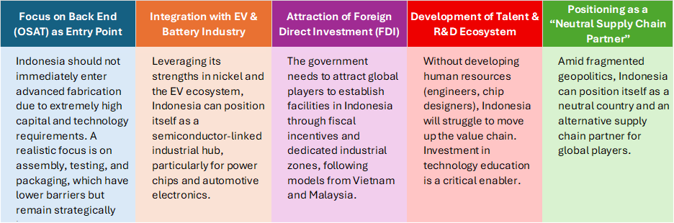
Indonesia’s semiconductor strategy should focus on realistic entry points like OSAT, leverage synergies with the EV and battery sectors, attract foreign investment, build local talent and R&D capabilities, and adopt a neutral supply chain positioning. This approach balances strategic growth with pragmatic resource management, enabling Indonesia to progressively move up the semiconductor value chain.
Disclaimer:
This article is prepared for informational and educational purposes only and is intended to provide general insights into global and Indonesian semiconductor industry trends, geopolitical developments, and potential strategic implications. The analysis, projections, and opinions expressed are based on publicly available data and sources believed to be reliable at the time of writing.
This content does not constitute investment advice, financial advice, legal advice, or any form of professional recommendation. The semiconductor industry is subject to rapid technological change, market volatility, policy shifts, and geopolitical risk, which may cause actual outcomes to differ materially from the views or projections presented herein.
Readers are encouraged to conduct their own independent research and consult professional advisors before making business, investment, or policy decisions based on this article.
References
Ø Council on Foreign Relations. (2025). US-Iran tensions: Global economic implications. Retrieved March 2026, from https://www.cfr.org
Ø International Energy Agency. (2026). Oil market report – March 2026. Retrieved from https://www.iea.org/reports/oil-market-report-march-2026
Ø McKinsey & Company. (2023). The semiconductor industry in 2023–2025: Navigating supply, demand, and technology shifts. McKinsey Insights.
Ø Semiconductor Industry Association. (2023). 2023 Factbook. Retrieved from https://www.semiconductors.org/resources/
Ø Gartner Research. (2023). Global semiconductor market forecast 2023–2026. Gartner.
Ø IC Insights. (2024). Capital spending & market analysis: Semiconductor equipment. IC Insights.
Ø TSMC Investor Relations. (2024). Annual report 2023–2024. Retrieved from https://www.tsmc.com/english/investorRelations
Ø Bloomberg Intelligence. (2026). Geopolitical risk index – Energy & technology sectors. Bloomberg.
Ø Reuters. (March 2026). Global supply chains feel pressure amid geopolitical tensions. Reuters.
Ø Trading Economics. (2024–2026). Coal, nickel, copper prices. Retrieved from https://tradingeconomics.com/
World Bank. (2026). Commodity markets outlook 2026. Retrieved from https://www.worldbank.org/en/research/commodity-markets