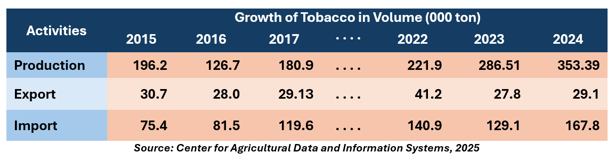
Tobacco remains a cornerstone commodity within Indonesia’s agricultural landscape, sustaining rural livelihoods while facing growing structural and external pressures. According to the Badan Pusat Statistik (Survei Perusahaan Perkebunan) and the Ministry of Agriculture (Directorate General of Estate Crops), national tobacco production reached 236.9 thousand tonnes in 2021, declined to 221.9 thousand tonnes in 2022, before rebounding to 286.5 thousand tonnes in 2023 and further rising to 353.4 thousand tonnes in 2024. The increase over the past two years reflects a recovery in planting area and improved weather conditions following earlier climate-related yield pressures. This trend suggests renewed growth momentum in the upstream tobacco sector, positioning Indonesia to maintain its strong regional role despite ongoing structural challenges.
The industry’s high geographic concentration is dominated by East Java, West Nusa Tenggara, and Central Java, which together contribute nearly 93% of total output-representing both a comparative advantage through specialized production clusters and a vulnerability to region-specific climatic or market shocks. Tobacco belongs to the Nicotiana genus, whose leaves serve as the main raw material for smoking and chewing products. The crop is highly sensitive to cultivation methods, location, and post-harvest handling, resulting in significant variations in quality across different agroecological zones.
Over the past decade (2015-2024), Indonesia’s tobacco production has grown at an average rate of around 5% annually, with the 2024 output marking one of the highest levels in recent history. East Java remains the primary producing province, accounting for nearly 47.7% of national output, with Jember Regency alone contributing over 29%. Jember is internationally recognized for its premium Besuki Na-Oogst (BNO) and Kasturi tobacco varieties, widely used as wrappers, binders, and fillers for high-end cigars. The global demand for BNO tobacco including from countries such as Cuba and the United States reflects Indonesia’s enduring comparative advantage in specific tobacco grades.
According to a joint projection by the Directorate General of Estate Crops (Ditjenbun), Statistics Indonesia (BPS), and the Agricultural Data and Information Center (Pusdatin), national production is expected to remain relatively stable at around 234,139 tonnes per year between 2023 and 2027. However, domestic availability is forecast to fluctuate, from 335,466 tonnes in 2023 down by 2.42% to 327,336 tonnes in 2024, and further decline to 317,244 tonnes in 2025 before recovering to 334,365 tonnes by 2027. These short-term supply variations likely reflect seasonal changes, shifting land allocation, and climate-related yield risks rather than structural decline.
Indonesia’s tobacco data shows a fluctuating pattern with a clear upward strengthening in recent years. Production moved unevenly between 2015 and 2017 but rose sharply starting in 2022 from 221.9 thousand tons to 353.39 thousand tons in 2024 reflecting field conditions such as more favorable weather, improved land productivity, and more competitive purchasing prices offered by major manufacturers. Meanwhile, exports remained relatively stable in the 28-29 thousand tons range, with a temporary spike in 2022, but weakened again due to stricter regulations in key markets and increasing competition from major producers such as Brazil and Zimbabwe. On the other hand, imports continued to rise from 75.4 thousand tons in 2015 to 167.8 thousand tons in 2024, indicating that Indonesia’s cigarette industry increasingly relies on higher-quality imported tobacco leaves for blending requirements that domestic production cannot yet fully satisfy.
In the trade dimension, Indonesia continues to rely on imports of raw tobacco from major suppliers such as China, Brazil, and India, even as its exports of manufactured tobacco products and cigarettes expand across Southeast Asia. Trade data show a faster rise in import volumes compared to exports, suggesting persistent supply-side gaps in quality consistency, varietal suitability, or year-round availability. Although farm-gate prices have grown at an estimated 5.8% per year (2008-2022) a positive signal for growers this price growth has not translated into stronger trade balance performance. The mismatch highlights the limited value captured at the upstream level and the need for better integration between primary production and downstream processing.
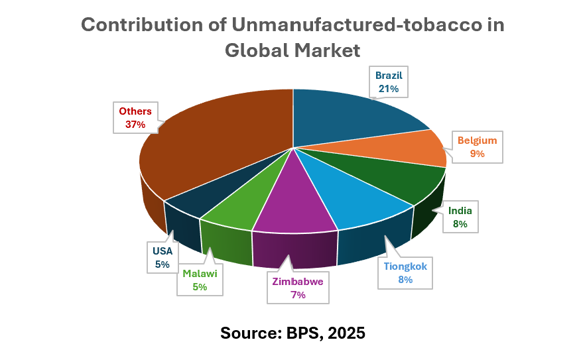
On the global stage, Indonesia ranks below major unmanufactured-tobacco exporters such as Brazil, Zimbabwe, the United States, India, and China, making it more exposed to fluctuations in global supply and price. Climate variability, including recent El Niño-related droughts in key producing countries, further amplifies these vulnerabilities.
To sustain long-term growth, Indonesia’s tobacco industry requires a two-pronged strategy:
- Strengthening upstream competitiveness through improved seed selection, irrigation systems, and post-harvest processing to reduce dependence on imported raw tobacco.
- Enhance domestic value addition by advancing local processing capacity, quality grading, and product traceability thereby retaining more value within the national supply chain and mitigating exposure to volatile international raw-leaf markets.
Indonesia’s current tobacco-industry challenges closely align with the two strategic priorities identified. At the upstream level, the country continues to rely heavily on imported premium tobacco due to inconsistent domestic quality, limited adoption of high-performing seeds, inadequate irrigation, and uneven post-harvest handling issues that directly weaken competitiveness and create supply vulnerabilities. At the downstream level, Indonesia still exports mostly raw leaf, with limited local processing, inconsistent grading standards, and weak traceability systems, all of which reduce value capture and make the industry highly exposed to volatile global raw-leaf prices. Strengthening upstream capacity and enhancing domestic value addition therefore directly address the structural constraints currently facing Indonesia’s tobacco sector while positioning it for more resilient, long-term growth.