The wholesale and retail trade sector remains a cornerstone of Indonesia’s economy, contributing 13.07% of national GDP in 2024, with non-automotive retail accounting for the largest share at 10.92%. This sector demonstrates consistent growth, supported by strong household consumption, expanding distribution networks, and the integration of modern trade formats. Quarterly GDP data from 2022 to 2025 reflects a steady upward trajectory, reaching nearly 799 trillion rupiah in Q3 2025, signaling robust consumer confidence and sustained demand.
Digital transformation is accelerating structural changes within the retail ecosystem. E-retail and marketplace transactions grew 6.19% quarter-on-quarter in Q3 2025, driven by widespread adoption of digital wallets, electronic payments, and high smartphone penetration. CRIF Indonesia highlights that this trend marks a shift toward omnichannel retail models, supported by logistics improvements and infrastructure investments. Despite risks such as inflationary pressures, regulatory changes, and logistical fragmentation, forecasts project 5% growth in 2025 and 4.95% in 2026, with retail market potential approaching USD 75 billion by 2030. These dynamics underscore the sector’s adaptability and its role as a key driver of domestic demand.
Contribution of the Retail Sector to National GDP
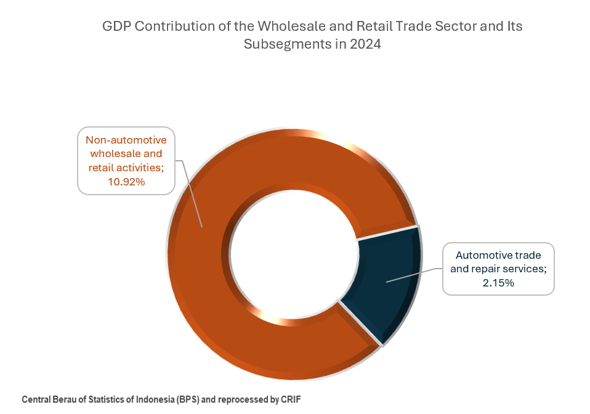
The latest BPS data indicates that the “Wholesale and Retail Trade; Repair of Motor Vehicles and Motorcycles” sector remains one of the largest contributors to Indonesia’s economy, accounting for 13.07 percent of national GDP in 2024. The segment is predominantly driven by non-automotive wholesale and retail activities, which contribute 10.92 percent, reflecting the strength of broad consumer trade and distribution channels across the country. Meanwhile, automotive trade and repair services add 2.15 percent, highlighting stable demand for vehicles and after-sales services. Overall, the sector’s substantial share underscores its strategic role in sustaining domestic consumption, supporting supply chains, and providing a consistent foundation for economic growth.
Top-Selling Retail Categories in Indonesia: Insights and Market Dynamics
Indonesia’s retail sector demonstrates strong performance across several key product categories, reflecting evolving consumer preferences and structural market shifts. Online retail channels continue to dominate growth, with e-retail and marketplace transactions rising 6.19% quarter-on-quarter in Q3 2025 (BPS). The most purchased categories include personal care products, household essentials, fashion, recreational and sports equipment, and transportation services. This surge is driven by digital adoption, widespread smartphone penetration, and the convenience of electronic payment systems, which have made e-commerce accessible even in semi-urban areas. Platforms such as Tokopedia and Shopee report that beauty and personal care, food and beverages, and home essentials consistently rank among the top-selling segments, supported by influencer marketing and flash-sale campaigns.
Offline retail remains resilient, as shown by Bank Indonesia’s Retail Sales Index (RSI) for October 2025. Growth was led by automotive spare parts and accessories (+12.0%), cultural and recreational goods (+6.7%), and food, beverages, and tobacco (+6.4%), underscoring strong demand for essential and lifestyle products. Conversely, categories such as information and communication equipment (-28.3%), clothing (-5.8%), and household appliances (-2.3%) recorded contractions, reflecting shifting consumer priorities toward digital and convenience-driven purchases. CRIF Indonesia notes that these patterns highlight a structural transition: while discretionary spending on fashion and electronics faces pressure, essential goods and automotive-related products remain stable drivers of retail growth.
Looking ahead, the interplay between digital transformation and consumer confidence will shape category performance. Personal care and fashion are expected to maintain momentum online, while household essentials and automotive accessories provide a buffer against economic volatility. With Indonesia’s retail market projected to reach USD 75 billion by 2030, retailers that leverage omnichannel strategies, optimize logistics, and align with evolving lifestyle trends will capture the largest share of this expanding market.
Quarterly gross domestic product data for wholesale and retail trade, including the repair of motor vehicles and motorcycles, indicates a steady and resilient performance from 2022 through 2025. The sector maintains consistent growth each year, supported by rising domestic demand, stable household consumption, and improving distribution efficiency across regions.
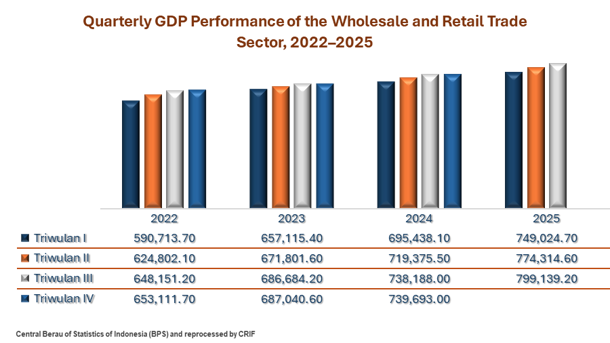
From 2022 to 2024, the sector records a clear upward trajectory, with quarterly values increasing from approximately 590 trillion rupiah in early 2022 to more than 739 trillion rupiah by the end of 2024. This reflects strengthened retail activity, expansion of modern trade formats, and a recovery in mobility and purchasing power. The quarterly pattern is also relatively stable, suggesting predictable seasonal dynamics with no major volatility.
Early 2025 data reinforce this positive trend. The first three quarters continue to rise, reaching nearly 799 trillion rupiah in the third quarter. Although the fourth quarter data is not yet available, the year is on track to surpass the performance of 2024. This momentum points to continued household spending resilience, stronger automotive-related trade, and growing integration between offline and digital retail channels.
Overall, the data confirms that the retail and wholesale sector remains one of the most robust contributors to Indonesia’s non-oil and gas economy. Its consistent expansion signals healthy consumer confidence and offers a strong foundation for further investment in modern retail formats, logistics improvements, and omnichannel strategies.
Current Condition and Market Transformation
According to official data from Statistics Indonesia (BPS), e-retail and marketplace transactions grew by 6.19% quarter-on-quarter in Q3 2025, compared to the previous quarter. The most purchased categories include personal care products, household essentials, fashion, recreational and sports equipment, and transportation services (ANTARA News). This surge reflects a broader digital transformation reshaping Indonesia’s retail landscape, driven by the adoption of digital wallets, electronic payment systems, and high smartphone penetration among consumers. These factors enable both modern and traditional retailers to extend their reach without the need for physical presence in every location, creating a more inclusive and scalable retail ecosystem (Mordor Intelligence).
CRIF Indonesia’s analysis suggests that this growth signals a structural shift toward omnichannel retail models, supported by evolving consumer behavior and technological advancements. Indonesian shoppers increasingly prioritize convenience, speed, and seamless experiences, making integrated online and offline channels essential. The proliferation of smartphones and secure digital payment systems has democratized access to e-commerce, while investments in logistics and infrastructure are critical for serving Indonesia’s geographically dispersed population. Despite risks such as inflationary pressures, regulatory changes, and logistical fragmentation, the sector remains resilient and adaptable. With forecasts projecting 5% growth in 2025 and 4.95% in 2026, and retail market potential approaching USD 75 billion by 2030, e-retail and marketplaces are positioned as core drivers of domestic demand and long-term retail transformation.
Projections for 2026 and Key Growth Drivers
The long-term trajectory of wholesale and retail trade in Indonesia shows a stable and resilient pattern, marked by cyclical fluctuations that reflect shifts in consumer purchasing power, macroeconomic conditions, and structural transitions within the retail ecosystem. Between 2013 and 2019, annual growth consistently ranged between 2.5 and 5 percent. This period represents a phase of steady expansion driven by rising household consumption, rapid urban retail development, and the ongoing modernization of distribution channels.
A sharp contraction occurred in 2020, with growth falling to minus 3.79 percent. This decline was tied directly to pandemic-related restrictions that limited mobility, disrupted supply chains, and weakened demand. Retail and wholesale activities, particularly those dependent on physical footfall, experienced significant pressure as consumer priorities shifted and spending power declined.
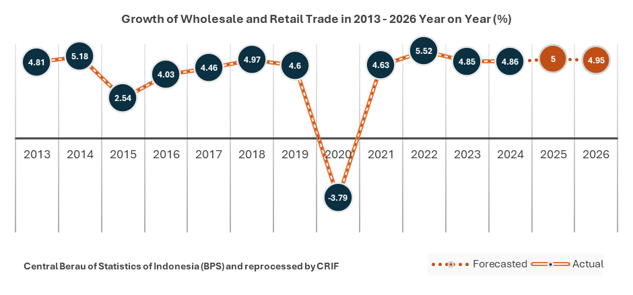
A strong rebound followed in 2021 and 2022, with growth improving to 4.63 and 5.52 percent respectively as economic activities normalised and both offline and online retail channels strengthened. Momentum stabilised in 2023 and 2024 at around 4.85 to 4.86 percent, indicating a mature sector supported by omnichannel retail integration, improved logistics, and resilient household demand.
Forecasts prepared by CRIF Indonesia indicate continued resilience for 2025 and 2026, with expected growth of 5 percent and 4.95 percent. These projections reflect stable consumption fundamentals supported by a steady macroeconomic environment. The sector’s recovery and sustained trajectory, as assessed by CRIF Indonesia, reinforce its position as a core driver of domestic demand and underline its adaptability amid shifting consumer behaviour and ongoing retail transformation.
Current Issues Affecting the Retail Sector
Indonesia’s retail sector is undergoing significant transformation, driven by structural changes and external challenges that impact both short-term performance and long-term resilience. The surge in online shopping remains the most prominent trend, reshaping consumer behavior and compelling retailers to accelerate digital adoption. This shift has created opportunities for growth through e-commerce and omnichannel strategies, but it also introduces challenges such as intensified competition, pressure on logistics networks, and the need for advanced technology integration to meet rising expectations for convenience and speed. CRIF Indonesia highlights that retailers who fail to adapt risk losing market share as consumers increasingly demand seamless experiences across physical and digital platforms.
Beyond digital dynamics, natural disasters pose a persistent risk to retail operations in Indonesia. Frequent floods, earthquakes, and volcanic eruptions disrupt supply chains, increase distribution costs, and create inventory shortages, particularly in remote and disaster-prone regions. These disruptions often lead to uneven recovery across provinces, making supply chain resilience and contingency planning a strategic priority for retailers. CRIF Indonesia emphasizes that investment in infrastructure and disaster preparedness will be critical to maintaining operational continuity and protecting margins in the face of these recurring challenges.
At the policy level, the government’s Makan Bergizi Gratis (MBG) program is emerging as a stabilizing force for household consumption. By improving nutritional access for schoolchildren, MBG indirectly supports demand for essential goods and strengthens baseline consumption, particularly among lower-income households. This initiative can help sustain retail activity during periods of economic uncertainty, but its success depends on effective implementation and consistent funding. CRIF Indonesia notes that such programs can mitigate volatility in consumer spending, provided they are complemented by broader fiscal stability and targeted social support.
Finally, consumer confidence and trust in government policies remain pivotal for retail growth. CRIF Indonesia’s analysis underscores that confidence in governance and economic stability directly influences household spending behavior. When trust levels are high, consumers are more willing to allocate discretionary income toward retail purchases, fueling growth across categories. Conversely, uncertainty in policy execution, disaster response, or fiscal management can dampen sentiment and slow sectoral expansion. For retailers, monitoring these macro-level indicators and aligning strategies with government initiatives will be essential to navigating an increasingly complex operating environment.
Indonesia’s retail sector stands at the intersection of resilience and transformation. Its consistent contribution to GDP and steady growth trajectory affirms its strategic importance in sustaining economic stability. The surge in online shopping and the adoption of digital payment systems is reshaping consumer behavior, compelling retailers to embrace omnichannel strategies and invest in technology-driven solutions. However, challenges such as natural disasters, infrastructure gaps, and regulatory uncertainties require proactive risk management and supply chain resilience.
Government initiatives like Makan Bergizi Gratis (MBG) provide a stabilizing influence on household consumption, while public trust in policy execution remains critical for sustaining confidence and spending. Looking ahead, the sector’s ability to balance innovation with operational efficiency will determine its success in capturing emerging opportunities. With strong fundamentals and a clear trajectory toward modernization, Indonesia’s retail industry is well-positioned to remain a core engine of growth through 2026 and beyond.