Indonesia’s residential property landscape is undergoing a significant shift as affordability challenges push more prospective buyers toward suburban markets. The steady rise in home prices, combined with upward pressure on mortgage rates, has made urban housing increasingly out of reach for many middle-income households. As a result, areas like Bogor, Tangerang, Bekasi, Sidoarjo, and Gresik are becoming preferred alternatives offering more attainable price points without fully sacrificing access to urban amenities. This shift is fueling stronger demand for compact landed homes, affordable cluster developments, and properties located within reach of mass transportation corridors. The growing movement toward suburban living not only reflects changing consumer priorities but also signals a structural transformation in Indonesia’s housing market one that becomes even clearer when viewed alongside recent data on price escalation and credit trends.
Credit Interest Rate Trend Chart, January 2023 - August 2025 (Source: BPS 2025)
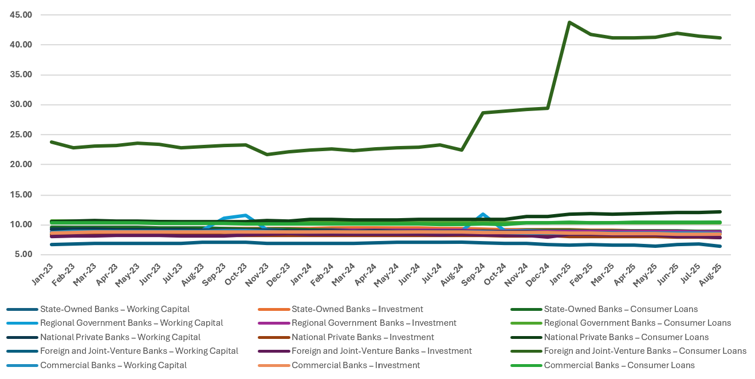
In line with shifting housing preferences, credit interest rate trends over the past three years show why affordability has become a growing challenge for urban homebuyers. Since early 2023, consumer lending rates, especially mortgages, have remained high at around 10.1% to 10.5% in commercial banks. While working capital and investment loan rates have eased, this improvement has not reached consumer credit. The pressure becomes clearer in 2024-2025, when consumer lending rates at private and foreign/joint-venture banks rise further into the 11% to above 12% range. These elevated borrowing costs continue to weaken household purchasing power, pushing many buyers to look toward more affordable suburban locations.
At the same time, movements in the Residential Property Price Index (IHPP) reinforce this shift. As of March 2024, property prices increased 2.76% year-on-year. Slightly slower than the 2.84% growth in 2023 but still rising. Landed houses rose 2.97%, particularly in cluster developments, where prices climbed between 3% and nearly 5%. Apartment prices, in contrast, fell 1.03%, signaling weaker demand for vertical housing and strengthening interest in low-density suburban homes.
Developers continue to raise prices due to steady demand, limited supply, and increasing basic costs. Land prices in surveyed project areas grew by 5%, and construction materials also became more expensive, reflected in a 0.85% year-on-year rise in the wholesale price index for building materials. Although this increase is lower than last year’s, rising land and material costs still add upward pressure on housing prices. Combined with high credit interest rates, these trends are pushing more households to seek suburban markets where housing remains relatively more attainable.
Developer Response Strategies: Prioritizing Mixed-Use and Transit-Oriented Development (TOD) Projects
Property developers in Indonesia are increasingly adopting mixed-use and Transit-Oriented Development (TOD) concepts as core strategies to capture the growing demand in suburban areas while leveraging the rapid expansion of public transport infrastructure. By developing townships and mixed-use projects connected directly to MRT, LRT, and commuter rail networks, developers are creating integrated environments that combine residential units with commercial areas, public spaces, and essential facilities. This approach reduces residents’ reliance on private vehicles, enhances the strategic appeal of each location, and allows developers to offer more competitive pricing through improved mobility efficiency and accessibility.
The current market context in Indonesia further strengthens the relevance of TOD-based development. Integrated projects along MRT and LRT corridors continue to expand through various investment partnerships and land-optimization initiatives near transit nodes. At the same time, developers such as Adhi Commuter Properti (ADCP) are advancing concepts like LRT City, residential and commercial clusters directly linked to the LRT Jabodebek system, aligning with the national agenda to enhance mass transportation capacity.
Demand for TOD is also being driven by the rising cost of homeownership due to relatively high mortgage rates, as well as shifting buyer preferences toward more affordable suburban locations. By combining housing, commercial activity, and direct transit access in one cohesive development, mixed-use TOD projects offer an attractive solution for buyers seeking to reduce daily mobility costs without compromising convenience or urban connectivity.
In the long term, this strategy is expected to strengthen property value appreciation along transit corridors and support Indonesia’s broader transition toward more integrated, efficient, and sustainable urban development.
Forward-Looking Implications: Increasing Valuation of Infrastructure-Linked Assets
Building on the momentum of their mixed-use and TOD strategies, developers now stand to benefit from a powerful secondary effect: infrastructure-driven asset appreciation. Indonesia’s accelerating infrastructure program from toll road expansion to LRT Jabodebek, MRT Phase 2, and high-speed rail is transforming suburban and urban fringe areas into vibrant, well-connected growth corridors. The development of MRT Jakarta Phase 2, spanning approximately 11.8 kilometers from Bundaran HI to Ancol Barat, is a significant example of this shift. Once completed, the North–South line will reach a total of 27.8 kilometers, enabling a seamless 45-minute journey from Lebak Bulus to Kota and enhancing connectivity across Jakarta’s central and northern districts. Phase 2A, consisting of seven underground stations from Thamrin to Kota, and Phase 2B, which extends the line to Mangga Dua and Ancol, will anchor new transit-oriented pockets supported by dense commercial, residential, and tourism activity. As accessibility improves around these corridors, where station spacing ranges from 600 meters to 1 kilometer and operations employ advanced CBTC signaling areas once considered peripheral are evolving into new urban nodes with increased land utility and development potential.
As a result, projects located near these expanding transit hubs are positioned to experience more stable and sustainable price appreciation, benefiting both investors seeking long-term gains and end-users who prioritize efficiency and mobility. Over time, this creates a virtuous cycle: better transit attracts new development, which enhances real estate value, which in turn brings more residents, businesses, and investment into the corridor. With MRT Phase 2 designated as a National Strategic Project and supported by official regional planning, its progression reinforces the long-term transformation of Indonesian cities into more integrated, efficient, and sustainable urban landscapes, solidifying transit-linked locations as the next frontier of property value growth.