Indonesia’s logistics sector moved from a post-pandemic rebound into a more mature growth phase over 2021-2023. The sector peaked in 2022, driven by reopening effects and e-commerce expansion, with rail transportation growing 69.75%, land transportation 66.9%, and air transportation 40.54%. By 2023, growth normalized toward mid-teens levels as base effects faded and operating costs re-anchored margins, establishing a more balanced structural baseline.
In 2024, growth became more differentiated across subsectors. Rail transportation led with 18.61% growth, supported by stronger industrial corridor utilization and improved port-to-inland connectivity, while land transportation grew 9.89%, warehousing and courier services 9.37%, and air transportation 6.75%. Maritime (4.44%) and river, lake, and ferry transport (2.42%) softened further, highlighting persistent structural frictions in seaborne logistics. In 2025, growth followed a seasonal pattern, with a Q1 uplift led by rail (17.56%) and normalization by Q3, when rail remained resilient (9.22%) but air transportation briefly contracted (-0.23%) amid rising cost sensitivity.
Looking ahead, logistics growth is expected to remain positive but moderate in 2025-2026, reflecting market maturity. Full-year 2025 growth is projected at 21.18% for rail, 17.86% for air, 13.64% for warehousing and courier services, and around 9-10% for land, maritime, and inland waterways. In 2026, growth is expected to ease slightly, with rail at 19.06%, air at 16.07%, warehousing at 12.28%, and other subsectors around 8-9%, indicating a shift toward efficiency-driven expansion focused on asset productivity, network optimization, and cost control rather than capacity growth.
Indonesia’s Logistics Position in the LPI and Recent Operational Reality
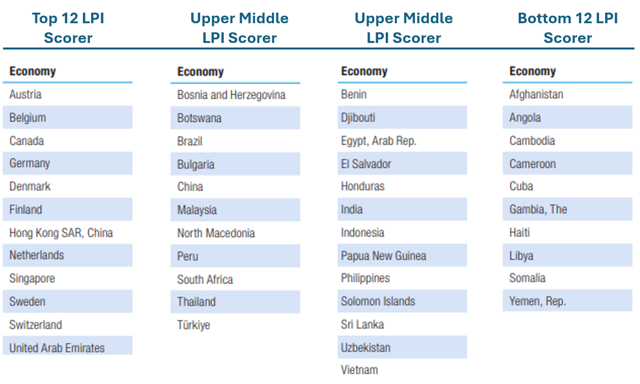
The Logistics Performance Index (LPI) 2023 places Indonesia at a score of 3.0, indicating a logistics system that is functional and capable of supporting trade, but not yet highly reliable or consistent. Indonesia ranks among the Top 13 lower-middle-income countries, reflecting a relatively strong structural position within its income group. However, the gap with peer countries and top-performing logistics nations remains material, particularly in terms of system integration and predictability.
Across the six LPI dimensions customs, infrastructure, international shipments, logistics competence, tracking and tracing, and timeliness, Indonesia’s performance is broadly mid-range. Timeliness stands out as the strongest indicator, while customs, infrastructure, and logistics competence remain relative weaknesses. Developments throughout 2025 largely confirm these assessments. Regulatory uncertainty and episodic operational restrictions continued to affect distribution flows, highlighting the logistics system’s sensitivity to administrative decisions and the limited penetration of risk-based and pre-arrival clearance mechanisms. Compared with high-performing countries such as Singapore and the Netherlands, Indonesia remains in transition toward more predictable, coordinated border management.
Infrastructure performance reflects a similar pattern. While investment in ports and hinterland services has improved performance at major gateways, efficiency gains remain uneven and concentrated. Dependence on a limited number of logistics nodes increases systemic vulnerability to disruption. At the operational level, logistics competence improved among select operators, but industry-wide performance remains uneven due to fragmentation and the absence of nationally consistent service standards. Digital tracking systems are increasingly available, yet end-to-end visibility remains constrained by limited interoperability and data governance challenges.
Overall, Indonesia’s experience in 2025 reinforces the view that the LPI 2023 captures underlying structural realities rather than short-term perceptions. The logistics system demonstrates resilience and basic functionality, but continued weaknesses in consistency, integration, and predictability constrain performance improvements. Future gains in Indonesia’s logistics competitiveness are therefore less dependent on expanding physical capacity and more on integrating processes, data, and operational standards across the logistics ecosystem, an essential step for closing the gap with peer and top-tier logistics economies.