Indonesia’s forestry sector recorded modest but positive production growth in recent years, driven by commercial plantation expansion (acacia, eucalyptus), pulp & paper output and steady furniture manufacturing. Official statistics and sector compilations indicate continued production of logs, processed timber and non-timber forest products through 2024, while forestry-related value added has contributed to overall agriculture/forestry growth spurts in early 2025. These gains, however, sit alongside a renewed uptick in forest loss: independent monitoring shows substantial primary-forest area reductions in recent years, with most recent datasets signalling hundreds of thousands of hectares of primary forest loss and elevated clearance inside legal concessions a dynamic that changes the character of “growth” from purely productive to extractive and land-conversion driven.

The chart shows relatively small but sharp fluctuations in forestry growth. The subsector was almost flat in 2020 - 2021, declined to about -1% in 2022, then jumped to +2.6% in 2023, before dropping steeply to around -2.0% in 2024. Growth returned close to zero in 2025, while projections for 2026 - 2027 suggest near stagnation with a slight negative at -0.2%. This pattern indicates that forestry growth is not structurally stable but rather influenced by short-term output cycles and policy conditions. Export demand during that period also contributed to temporary growth. However, part of this increase may also have come from land clearing or intensive harvesting, which inflates output figures but does not reflect long-term sustainable management.
The steep contraction in 2024 and the projected stagnation afterwards can be linked to several interrelated factors: tighter environmental policies and licensing controls, rising international scrutiny on deforestation-free supply chains (e.g., SVLK and EU Deforestation Regulation), and reputational risks from reports of clearing inside legal concessions. These pressures reduce market access and force supply restructuring. At the same time, high certification and compliance costs limit smallholders’ participation, lowering aggregate output even when global demand remains. As noted in the MR, stronger traceability systems, group certification support, and downstream investment are essential to stabilize the sector’s growth while meeting international sustainability expectations.
Market Structure, Value Chains, and Competitive Position
Indonesia’s forestry industry is dual large track, pulp & paper conglomerates, plantation owners, furniture exporters as vertically integrated actors, operate alongside millions of smallholders, micro-enterprises and informal sawmill networks. Acacia and fast-growing pulpwood species dominate pulp supply, while tropical hardwoods such as teak remain important for higher-value furniture and specialty markets. Pulp, paper and panel products account for a significant share of export value, while furniture and wooden handicrafts contribute meaningful employment and foreign exchange. The sector benefits from abundant forest area and existing processing capacity, but competitiveness depends on cost-efficient logistics, access to certified fibre, and the ability to meet buyer sustainability and traceability requirements.
Based on that, integration into global value chains (large buyers, retail and OEMs) favors players who can offer scale, consistent quality and documented legality. Smallholders and informal processors often lack the administrative capacity and capital to comply with complex buyer due diligence, which concentrates premium margins with larger, certified firms.
Export-Import Dynamics and Key Markets
Indonesia’s wood and wood-product exports span pulp & paper, processed wood (plywood, veneer), furniture and specialty timbers. Major destinations include the United States, EU, Japan and regional Asian markets; export earnings for furniture and wood products reached close to multi-billion-dollar levels in the 2023 - 2024 window. Imports are limited and mostly centered on specific machinery, specialty finishes, and some temperate-wood items not produced domestically. Export growth is supported by scale and competitive labour costs, but the top export markets increasingly demand documented legality (SVLK/FLEGT) and, more recently, proof of deforestation-free supply chains.
Export orientation explains investment in processing capacity and plantations, but reliance on export markets makes Indonesia sensitive to regulatory changes (buyer country procurement rules, sustainability standards) and reputational risk stemming from deforestation or supply-chain gaps.
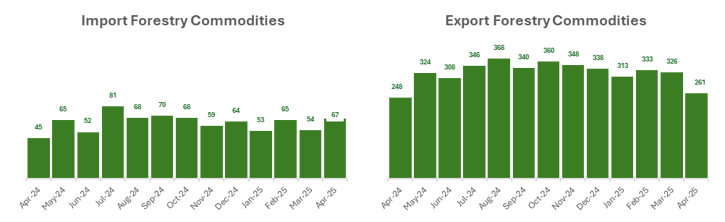
Source: Statistics of Indonesia, 2025
The data on forestry commodities shows Indonesia’s strong position as a net exporter, with exports consistently outpacing imports by a wide margin. Imports remained relatively modest between 45 - 81 million USD from April 2024 to April 2025, reflecting the fact that Indonesia only brings in limited specialized products such as certain machinery, finishing materials, or wood types not available locally. The spike in July 2024 (81 million USD) indicates seasonal demand from the furniture and construction industries preparing for export cycles, while the dip in early 2025 (53 million USD in February) suggests temporary adjustments in supply chains before recovering to 67 million USD in April 2025. In contrast, exports ranged from 248 - 368 million USD, underscoring the sector’s crucial role in foreign exchange earnings. The peak in August 2024 (368 million USD) coincides with high international demand from markets such as the US, EU, and China, typically linked to retail procurement cycles, while the decline in April 2025 (261 million USD) reflects external pressures such as stricter sustainability regulations, global price corrections, or logistical challenges. Overall, the data emphasizes that while imports are supplementary and stable, exports remain the key driver, though they are vulnerable to global demand shifts and compliance requirements, highlighting the importance of diversification, certification, and downstream value addition for long-term resilience.
Industry Prospect and Potency
- Scale up certified plantation fibre and downstream upgrading.
Expanding sustainably certified pulpwood plantations (acacia/eucalyptus) and investing in higher-margin downstream processing (furniture finishing, engineered wood, panel products) can capture more value domestically and reduce vulnerability to commodity swings.
- Non-timber forest products (NTFPs) & circular bio-industries.
Products such as rattan, resin, essential oils and charcoal for activated carbon can diversify revenue and provide rural livelihoods without requiring further primary-forest conversion.
- Traceability and digital verification services.
There is a commercial opportunity in providing compliance services (geolocation, chain-of-custody IT systems, audit facilitation) that help small and medium enterprises meet buyer due diligence at acceptable cost.
Indonesia’s forestry sector has genuine potential to expand value capture through plantation management, downstream processing and diversified forest products. That potential, however, is conditional on the sector’s ability to reconcile production growth with credible, verifiable sustainability. Evidence of increased forest loss (even inside legal concessions) and rising international due-diligence expectations mean that long-term access to premium markets will hinge on traceability, certification and governance reforms. If policymakers, industry and donors collaborate to lower compliance costs for small producers, scale certified plantations responsibly and tighten transparency on land use, Indonesia can retain its competitive edge while meeting the world’s zero-deforestation expectations turning an immediate liability into a long-term comparative advantage.