Executive Summary: A Concise & Structured Snapshot of Indonesia’s Current Landscape
Indonesia enters 2026 with relatively solid macroeconomic fundamentals, yet faces mounting pressures from two fronts: external shocks, including U.S. tariff policies, global financial market volatility, and geopolitical tensions, and domestic challenges, such as capital market weakening, rupiah depreciation, and governance uncertainties surrounding new institutional frameworks like Danantara.
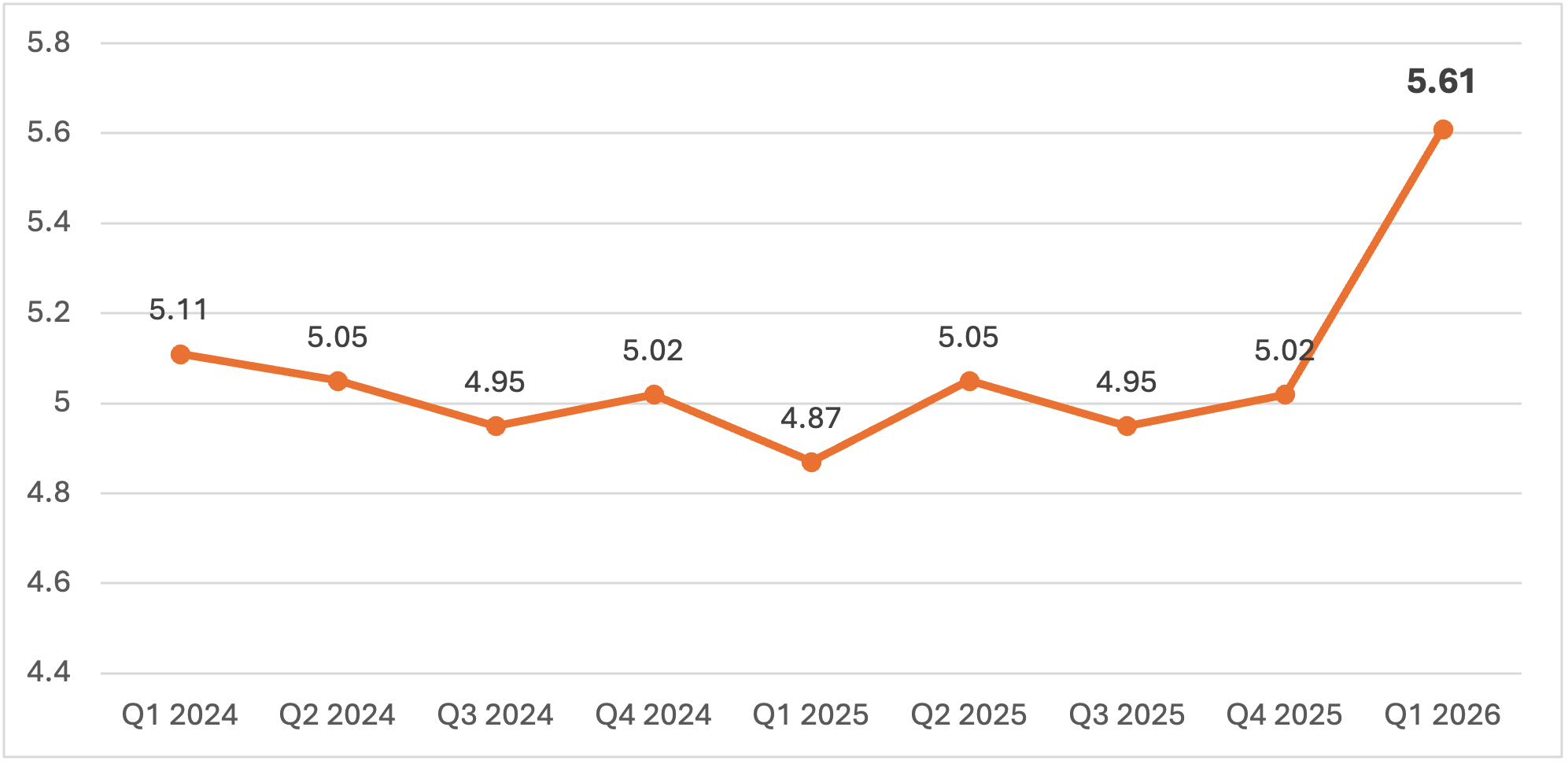
On the positive side, GDP growth in Q1 2026 reached 5.61% (YoY), the highest first-quarter performance in 13 years. This figure exceeded projections from multiple international institutions and positioned Indonesia ahead of many G20 peers. Household consumption remains the primary growth engine, supported by seasonal momentum from Ramadan and Eid festivities.
Key Economic Indicators
1) 5.61% – GDP Growth (Q1 2026). Highest level in 13 years
2) IDR 17,950/USD – Exchange Rate (June 2026). Previously touched IDR 18,000
3) -36% – Jakarta Composite Index (JCI) decline from peak. Among the worst-performing of 90 global indices
4) 5.25% – BI Policy Rate (May 2026). Increased by 50 bps from 4.75%
5) 9.96% – Credit Growth (Jan 2026). Within Bank Indonesia’s target range of 8–12%
6) IDR 240 Trillion – State Budget Deficit (Q1 2026). Equivalent to 0.93% of GDP (vs. 0.43% in Q1 2025)
“Indonesia’s economy demonstrates strong fundamentals by achieving 5.61% growth in Q1 2026, outperforming most G20 countries such as China and South Korea.”
Coordinating Ministry for Economic Affairs, May 2026
Despite strong GDP performance, financial markets told a contrasting story in the first half of 2026. As of early June 2026, the Jakarta Composite Index (JCI) had dropped to its lowest level since June 2021 — down roughly 31% year-to-date — making it one of the worst performers among more than 90 global indices tracked by Bloomberg. The rupiah weakened to around IDR 17,950–18,000 per USD during the same period, near its weakest level on record. Foreign investors recorded cumulative net outflows of approximately IDR 61.3–66.2 trillion year-to-date as of early June 2026, signaling a pronounced "Sell Indonesia" sentiment not seen in the past two decades. (Note: As of mid-August 2026, the JCI has since recovered part of these losses, though it remains down about 21% year-on-year.)
Key Emerging Trends
Indonesia’s 2026 economic and financial landscape is shaped by several major trends:
- Divergence between real economic growth and financial market performance
- Rising fiscal pressure driven by priority programs such as Free Nutritious Meals (MBG) and village development initiatives
- Capital market governance reforms in response to MSCI-related pressures
- Monetary tightening, marked by the first BI rate hike in two years
- Accelerating digital transformation across the financial sector
Macroeconomic & Fiscal Indicators: Data, Trends, and Insights
GDP Growth - Strong Upward Momentum
Indonesia’s economy recorded 5.61% YoY growth in Q1 2026, marking a notable acceleration from 4.87% in Q1 2025. This performance represents the strongest first-quarter growth in 13 years, highlighting resilient domestic demand.
Regionally, Java remains the dominant contributor, accounting for 57.24% of GDP, with growth reaching 5.79% YoY, underscoring continued economic concentration.
GDP Growth Trend (Quarterly, % YoY)
Source: Badan Pusat Statistik (BPS), 2026
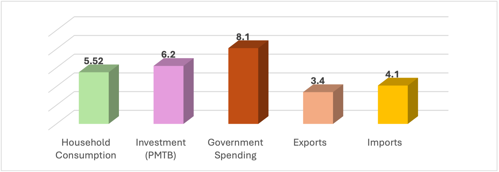
GDP Composition by Expenditure (% Q1 2026)
Sourcs: BPS, May 2026
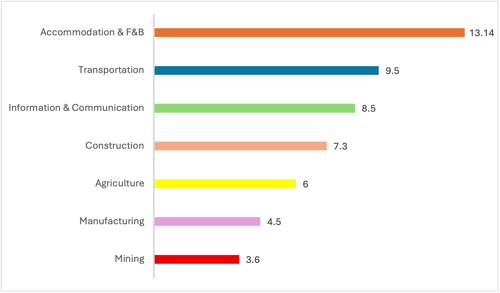
Top Growing Sectors (% Q1 2026)
Source: BPS, May 2026
Indonesia's early 2026 economic expansion remains consumption-driven, buoyed by Ramadan and Eid spending, while an 8% government expenditure surge adds short-term momentum but raises fiscal sustainability concerns amid a widening budget deficit. Sectorally, services like accommodation and transportation are thriving from mobility recovery, whereas capital-intensive industries such as manufacturing and mining lag, revealing limited progress toward deeper industrialization. Most notably, a growing disconnect between solid real-sector performance and deteriorating financial market signals, including equity weakness, currency pressure, and capital outflows, suggests that while the surface economy looks resilient, underlying financial vulnerabilities are quietly building and may threaten forward-looking stability.
Inflation - Stable, Rising Cost Pressures Ahead
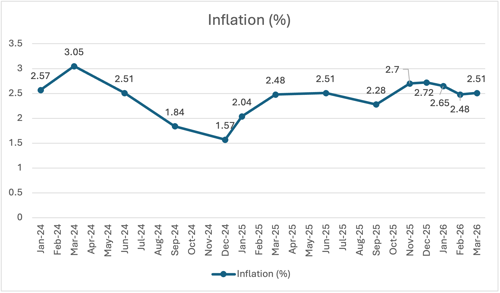
Inflation remained well-controlled at ~2.7% YoY entering 2026, aligning with Bank Indonesia’s target range of 2.5% ±1%.
Inflation Trend vs Target (2024–2026)
Source: BPS & Bank Indonesia, 2026
Inflation in Indonesia remains well-controlled at around 2.7% YoY entering 2026, staying within Bank Indonesia's 2.5% ±1% target range and reflecting stable prices alongside healthy domestic purchasing power, suggesting a demand-supported rather than overheated economy. However, underlying risks are gradually mounting, as rupiah depreciation is driving up imported goods prices while rising global oil prices strain the government's subsidy burden and inject cost-push pressures across multiple sectors. Looking ahead, while inflation has so far been anchored by stable demand conditions, early signals point to a potential shift toward cost-driven pressures in the second half of 2026, which could compel tighter monetary policy responses as policymakers work to preserve price stability in an increasingly challenging external environment.
Fiscal Position - Mounting Pressures
Indonesia’s fiscal balance shows clear signs of stress:
Fiscal Indicators (Q1 2025 vs Q1 2026)
|
Indicator |
Q1 2025 |
Q1 2026 |
Change |
|
Budget Deficit (% of GDP) |
0,43% |
0,93% |
▲ +0,50 pp |
|
Nominal Deficit |
~IDR 110T |
IDR 240,1T |
▲ +118% |
|
Revenue Growth |
- |
+10,5% YoY |
- |
|
Expenditure Growth |
- |
+31,4% YoY |
- |
|
Budget Realization |
- |
21,2% of APBN |
- |
Source: BPS & Bank Indonesia, 2026
Indonesia's fiscal position in 2026 is under mounting pressure, with state expenditure surging 31.4% year-on-year far outpacing revenue growth of 10.5%, causing the budget deficit to nearly double from 0.43% to 0.93% of GDP and the nominal deficit to spike 118% to IDR 240.1 trillion, raising concerns about approaching the 3% of GDP legal threshold that could trigger sovereign credit rating downgrades, higher borrowing costs, and broader financial market volatility. Strategically, Indonesia faces a delicate balancing act where fiscal expansion supports near-term GDP performance, yet a weakening rupiah, capital outflows, and widening deficits collectively signal early-stage macro-financial fragility that risks undermining long-term stability, even as structural opportunities in digital economy, tourism, logistics, and fintech, alongside 9% credit growth, offer viable pathways for more sustainable expansion. Ultimately, Indonesia's 2026 macroeconomic landscape is characterized by strong but uneven growth, stable but forward-threatened inflation, and supportive but increasingly stretched fiscal policy, making the preservation of investor confidence and the careful calibration of growth momentum against macroeconomic stability the defining policy challenge ahead.
Financial Sector: Banking & Credit Dynamics
Amid heightened financial market volatility, Indonesia’s banking sector continues to demonstrate relative resilience, supported by stable liquidity conditions, manageable asset quality, and steady credit growth. However, the recent BI Rate hike in May 2026 has introduced new headwinds that could weigh on future credit expansion and borrowing costs.
A. Interest Rate Dynamics - Growth vs Stability Dilemma
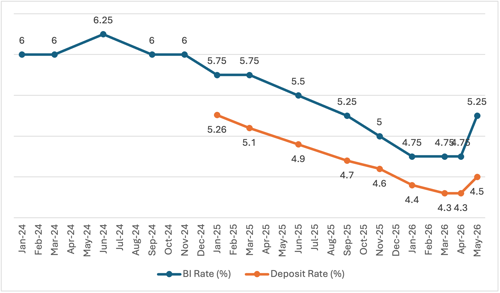
The trajectory of Bank Indonesia’s policy rate throughout 2024–2026 reflects a clear policy trade-off between sustaining economic growth and stabilizing the rupiah. After maintaining a relatively accommodative stance at 4.75% since late 2025, Bank Indonesia raised the benchmark rate by 50 basis points to 5.25% in May 2026, marking the first hike in two years.
At the same time, deposit rates have gradually declined before stabilizing, indicating lagged transmission of monetary policy to the banking system.
Interest Rate Trend (BI Rate vs 1-Month Deposit Rate)
Source: Bank Indonesia, 2026
Indonesia's recent shift toward tighter monetary conditions, aimed at defending the rupiah and stabilizing external balances, carries several forward-looking implications for the banking sector despite the system remaining fundamentally sound. Policy rate increases are expected to transmit rapidly into lending rates, creating downside risks to credit demand particularly for interest-sensitive segments such as consumer loans, mortgages, and SMEs, while capital outflow pressures may intensify competition for deposits and gradually compress net interest margins over time. Simultaneously, banks are likely to pivot from aggressive credit expansion toward more selective, risk-aware lending strategies, prioritizing asset quality amid macroeconomic uncertainties and currency volatility — creating a structural tension given that Indonesia still requires approximately 9% credit growth to sustain financial deepening and economic momentum. Ultimately, Indonesia's banking sector is entering a more cautious, segmented phase where credit growth remains positive but faces downward pressure, interest rate hikes bolster stability at the cost of higher borrowing costs, and the defining challenge ahead lies in sustaining credit expansion without compromising financial stability in an increasingly volatile macro-financial environment.
B. Bank Credit Growth - Strong but Uneven Expansion
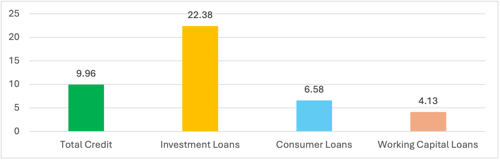
Indonesia’s banking sector recorded 9.96% YoY credit growth in January 2026, remaining within Bank Indonesia’s target range of 8–12%, signaling continued financial intermediation momentum. However, the composition of growth reveals a highly uneven pattern, with investment loans surging at 22.38% YoY, far outpacing other segments. In contrast, working capital loans grew modestly at 4.13% YoY, while consumer loans expanded at 6.58% YoY, reflecting relatively more cautious household borrowing behavior.
Bank Credit Growth by Type (January 2026, % YoY)
Source: Bank Indonesia, February 2026
The credit landscape in Indonesia is undergoing a notable structural shift toward investment-led financing, as strong expansion in investment credit signals that corporations are actively pursuing long-term capacity building and capital expenditure, particularly in infrastructure and strategic sectors, which bodes well for future economic productivity given that investment-driven growth carries more sustainable long-term impacts than consumption alone. However, relatively subdued working capital loan growth reveals a more cautious business stance toward short-term operations, likely reflecting demand uncertainty, rising input costs, and tighter liquidity conditions amid currency volatility and global pressures, while moderate consumer lending growth suggests households continue expanding consumption but at a measured pace constrained by higher interest rates and cost-of-living pressures. Taken together, while the pivot toward investment-led credit supports long-term growth prospects, it simultaneously introduces concentration risk by making overall credit expansion increasingly dependent on fewer sectors and large-scale projects, underscoring the need for broader-based credit participation to ensure more balanced and resilient financial sector development.
C. Lending Rates - Gradual Transmission of Monetary Tightening
Bank Indonesia data shows that average lending rates for commercial banks reached ~8.03% in March 2026, with variations across loan types. Working capital loans averaged 8.21%, investment loans 8.93%, and consumer loans at even higher levels.
Lending & Interest Rate Indicators (% per annum)
|
Indicator |
Oct 2025 |
Nov 2025 |
Dec 2025 |
Jan 2026 |
Feb 2026 |
Mar 2026 |
|
BI Rate (%) |
6.00 |
5.75 |
4.75 |
4.75 |
4.75 |
4.75→ 5.25 |
|
1M Deposit Rate (%) |
4.75 |
4.60 |
– |
4.13 |
– |
– |
|
Working Capital Loan Rate (%) |
8.89 |
8.67 |
8.44 |
8.32 |
8.28 |
8.21 |
|
Investment Loan Rate (%) |
8.94 |
8.92 |
8.97 |
8.96 |
8.95 |
8.93 |
|
Money Supply Growth (M0, % YoY) |
– |
– |
11.4 |
11.0 |
– |
– |
*The BI Rate was increased to 5.25% on May 19–20, 2026.
Source: Bank Indonesia SEKI & BI press release, 2026.
Indonesia's banking credit dynamics reflect a resilient but increasingly complex landscape, where lending rates have not yet fully adjusted upward following the BI Rate increase in May 2026, pointing to a lagging transmission mechanism as banks gradually reprice loans under competitive pressures and the imperative to sustain credit growth. This creates a dual balancing challenge for banks: while higher benchmark rates will eventually lift loan yields and support interest income, the risk of deposit rates rising more aggressively amid liquidity competition threatens to compress Net Interest Margins over time. Rate-sensitive segments such as property and SME financing face particular vulnerability, as mortgage and working capital financing adjustments could dampen credit demand in these sectors, further reinforcing the already uneven and concentrated nature of credit growth. Ultimately, with credit expansion remaining solid but heavily skewed toward investment lending and policy transmission still incomplete, the key forward risk lies in tightening financial conditions gradually moderating overall credit growth while compelling banks to carefully recalibrate their lending strategies to balance asset quality, margin preservation, and sustainable sectoral expansion.
Capital Markets: Equities, Bonds & Foreign Capital Flows
Indonesia’s capital market in 2026 is experiencing one of its most severe stress periods in decades, driven by a combination of structural and cyclical factors. The convergence of MSCI index freeze concerns, negative outlook revisions by Moody’s and Fitch, rupiah depreciation, and widening fiscal deficits has triggered a persistent wave of negative sentiment that is difficult to reverse.
A defining theme emerging this year is the intensifying “Sell Indonesia” phenomenon, marked by sharp equity declines, sustained foreign capital outflows, and increasing pressure on the currency.
Equity Market Performance - Broad-Based Weakness
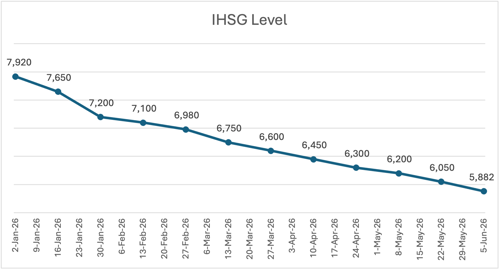
The Jakarta Composite Index (JCI) has experienced a steep and consistent downtrend, declining by approximately 36% from its recent peak and becoming one of the worst-performing indices globally in 2026. The decline has been gradual but persistent, indicating structural rather than purely cyclical pressures.
JCI Movement (Jan–Jun 2026)
Source: Indonesia Stock Exchange (IDX) & various media, 2026.
Currency Pressure - Rupiah Depreciation Trend
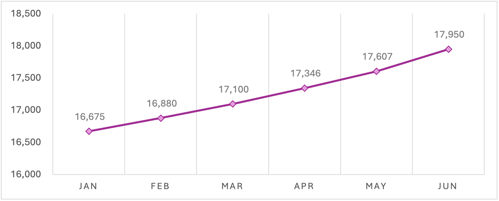
The rupiah has shown a steady weakening trend throughout H1 2026, reflecting both external pressures (global rates, oil prices) and domestic concerns (capital outflows, fiscal deficits).
USD/IDR Exchange Rate (Jan–Jun 2026)
Source: Bank Indonesia, 2026
Foreign Capital Flows - Persistent Outflows
Foreign investors have recorded significant and continuous net outflows from Indonesian financial markets, reinforcing downward pressure on both equities and the rupiah.
Foreign Net Flow (Equity & Bonds, 2026, IDR Trillion)
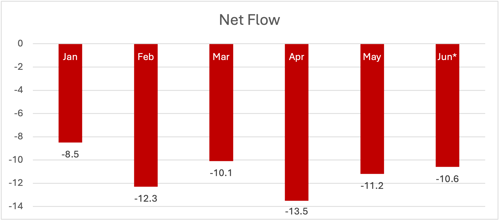
*June partial data
Source: Indonesia Stock Exchange (IDX) & various media, 2026.
Market Outlook - JCI Target Projections
|
Institution |
Target JCI 2026 |
Bull Case |
Bear Case |
|
Ciptadana Sekuritas |
7.780 (↓ from 8.960) |
- |
- |
|
BRI Danareksa Sekuritas |
7.200 |
8.600 |
6.550 |
Indonesia's capital market downturn in 2026 reflects a structural shift in investor perception rather than mere cyclical volatility, driven by a confluence of deteriorating financial indicators including the rupiah's steady depreciation from IDR 16,675 in January to nearly IDR 17,950 per USD by June, persistent net foreign outflows exceeding IDR 60 trillion year-to-date across both equities and bonds, and broad equity market declines that together form a self-reinforcing negative feedback loop where capital outflows weaken the currency, depreciation triggers further risk-off sentiment, and accelerating equity corrections deepen financial market fragility. Beyond external pressures from elevated U.S. rates and tightening global liquidity, domestic factors are amplifying the impact, as investor concerns over governance issues, policy inconsistency, and MSCI reclassification risks signal a confidence shock that transcends purely earnings-driven adjustments, confirming a broader portfolio reallocation away from Indonesian assets. While Indonesian equities are increasingly trading below historical valuation averages, presenting compelling long-term entry opportunities, low valuations alone remain insufficient to attract inflows without a credible restoration of confidence. Looking ahead, Indonesia faces a dual-path scenario where continued outflows and currency instability risk prolonging market weakness, yet the country's strong domestic demand and structural growth story retain significant rebound potential, making the ability to deliver consistent policy direction, strengthened governance, and sustained macroeconomic stability the decisive factor in determining the long-term trajectory of its capital markets.
Sectoral Growth: Where is the Strongest Momentum Emerging?
Indonesia’s Q1 2026 economic performance reveals that several sectors are significantly outperforming the national GDP growth rate of 5.61%, highlighting key engines of expansion and offering critical signals for investment and financial sector strategies.
Sectoral Growth Performance (Q1 2026, % YoY)
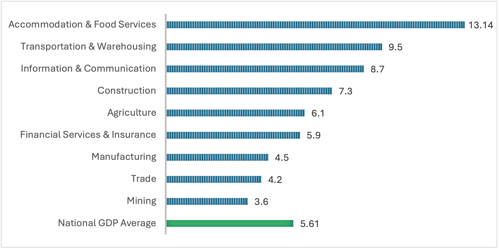
Source: BPS, May 2026
Key Drivers & Financial Sector Implications
|
Sector |
Key Growth Drivers |
Impact on Financial Sector |
|
Accommodation & F&B |
Ramadan, Eid, tourism rebound |
Surge in MSME working capital loans, spikes in digital payments |
|
Transportation & Logistics |
Seasonal travel, e-commerce expansion |
Growth in vehicle financing, logistics fintech solutions |
|
Information & Communication |
Digitalization, AI, cloud adoption |
Expansion of fintech, digital banking, payments ecosystem |
|
Construction |
Infrastructure projects, housing programs |
Increased mortgage (KPR), project financing, infrastructure bonds |
|
Agriculture |
Food security programs (MBG) |
Growth in agricultural credit, insurance |
|
Manufacturing |
Commodity downstreaming, export pressure |
Investment loans growth, exposure to trade risks |
|
Mining |
Commodity demand (nickel, coal, copper) |
Stable equity performance, commodity financing |
Indonesia's sectoral growth in 2026 is clearly dominated by service-based and digitally-driven industries, with accommodation, transportation, construction, and information & communication sectors leading expansion, fueled by a combination of seasonal consumption patterns such as Ramadan and Eid, structural digital transformation, and rising domestic demand, while the relatively moderate performance of manufacturing and mining reveals persistent constraints from export tariffs, global demand uncertainty, and limited progress toward high-value industrial deepening that could otherwise unlock greater long-term productivity gains. This growth composition creates a dual dynamic for the financial sector: on the opportunity side, rapid expansion in accommodation, food services, and digital platforms is driving surging MSME financing demand and digital transaction volumes, construction growth is boosting mortgage and infrastructure lending, and the thriving information & communication sector is acting as a powerful catalyst for fintech, digital banking, and payment ecosystem innovation; on the risk side, over-reliance on consumption-led sectors, weak industrial broadening, and credit exposure to export-oriented industries facing external pressures introduce portfolio concentration risks and vulnerability to external shocks. Ultimately, while Indonesia's increasingly service- and digitally-oriented growth trajectory offers compelling opportunities for financial sector expansion beyond traditional banking, long-term sustainability will critically depend on achieving a more balanced growth structure that pairs service sector dynamism with stronger industrial competitiveness and export diversification.
Financial Development Opportunities & Strategic Conclusions
Key Indicators Signaling Emerging Opportunities
Despite significant macro-financial pressures, several core indicators confirm the presence of real and actionable opportunities within Indonesia’s financial sector. Strong economic growth remains evident, with GDP expanding by 5.61% in Q1 2026, placing Indonesia above most G20 peers and highlighting resilient domestic fundamentals. At the same time, equity valuations have corrected to around ~10x forward PE, significantly below historical averages, indicating that Indonesian assets are currently in a deep value territory attractive for long-term investors.
On the demand side, consumer confidence has strengthened (index rising from 121 to 124), supporting sustained household consumption as a key growth driver. Meanwhile, investment credit growth reaching 22.38% YoY reflects ongoing corporate expansion and long-term capital formation. Importantly, Indonesia has maintained its investment-grade sovereign rating (Baa2), preserving credibility in global financial markets. External conditions have also moderately improved, with U.S. tariffs reduced to 19%, providing relatively better export competitiveness compared to earlier projections.
Opportunity Indicators
|
Indicator |
Value |
Strategic Interpretation |
|
GDP Growth (Q1 2026) |
5.61% |
Strong macro fundamentals; growth resilience |
|
Forward PE (IHSG) |
~10x |
Undervalued equities; accumulation opportunity |
|
Investment Credit Growth |
22.38% YoY |
Strong capex cycle; forward growth signal |
|
Consumer Confidence Index |
121 → 124 |
Sustained consumption momentum |
|
Sovereign Rating (Moody’s) |
Baa2 |
Rating affirmed at investment-grade, but outlook revised from Stable to Negative (5 Feb 2026), citing reduced policy predictability and governance risks |
|
U.S. Tariff Adjustment |
19% |
Improved export positioning |
Emerging Financial Development Opportunities
1. Capital Market Revaluation
Indonesia’s equity market is currently trading at historically discounted valuations, creating a compelling entry point for investors with a long-term horizon. The combination of low valuation multiples and strong underlying growth suggests potential for a significant rebound (relief rally) once uncertainties, particularly MSCI-related risks, are resolved. This positions the capital market as a high-risk, high-return opportunity in the near term.
2. Digital Ecosystem & Fintech Expansion
The rapid acceleration of digital financial services, driven by QRIS adoption, open banking initiatives, and fintech innovation, positions Indonesia as one of the largest digital finance markets in ASEAN. The biggest opportunity lies in serving the unbanked and underbanked MSME segment (~60 million enterprises), as well as expanding into digital insurance and technology-driven wealth management solutions.
3. Islamic Finance as a Global Growth Lever
Indonesia possesses a structural advantage in Islamic finance, supported by its large Muslim population (~240 million), maturing regulatory ecosystem, and government ambition to become a global Islamic finance hub. Segments such as sukuk markets, Islamic retail products, and sharia fintech platforms are expected to deliver some of the longest growth runways in the financial sector.
4. Government Bonds (SBN) & Fixed-Income Appeal
With the BI Rate rising to 5.25%, yields on government bonds have become more attractive, especially for conservative investors seeking stable returns. Retail instruments such as ORI, SR, and Sukuk Ritel offer competitive yields with relatively low risk, positioning fixed income as a defensive investment strategy amid market volatility.
5. Downstreaming & Strategic Commodities Financing
Indonesia’s push for commodity downstreaming (nickel, copper, bauxite) creates significant financing opportunities in infrastructure, smelter development, and supply chain integration. As the largest global nickel reserve holder, Indonesia is strategically positioned in the global EV battery ecosystem, making this sector highly attractive for long-term capital allocation.
Opportunity Mapping (Potential vs Risk)
|
Financial Segment |
Growth Potential (1–10) |
Risk Level (1–10) |
Strategic Position |
|
Government Bonds (SBN) |
8 |
3 |
Stable, defensive income |
|
Islamic Finance |
9 |
7 |
High-growth structural play |
|
Digital Finance/Fintech |
7 |
8 |
High growth, high competition |
|
Equities (IHSG) |
5 |
8 |
Undervalued, recovery play |
|
Bank Credit (Investment) |
7 |
5 |
Supported by capex cycle |
|
Downstream Commodities |
6 |
6 |
Strategic, policy-driven |
|
Property/Mortgage |
5 |
4 |
Moderate growth, rate-sensitive |
Source: Analysis based on data from BPS, Bank Indonesia, OJK, and various research institutions, 2026.
Indonesia’s financial landscape in 2026 reflects a classic divergence between strong real-sector fundamentals and weak financial market sentiment, creating a unique investment environment characterized by mispricing and asymmetric opportunities.
On one hand, macroeconomic indicators, GDP growth, credit expansion, and consumption, remain robust, indicating that the underlying economy is fundamentally sound. On the other hand, financial markets are under pressure due to confidence-related factors, including governance concerns, currency depreciation, and global risk sentiment.
This divergence creates opportunities across different asset classes:
1) Equities offer deep value but require risk tolerance and timing
2) Bonds provide stability and attractive yields in a rising rate environment
3) Digital finance and fintech represent structural growth with long-term upside
4) Islamic finance stands out as an underpenetrated, high-potential segment
However, the key risk lies in policy credibility and investor confidence. Without clear improvements in governance, transparency, and macro stability, these opportunities may remain under-realized in the short term.
Conclusion: A Market of Paradox and Opportunity
Indonesia in 2026 presents a paradoxical landscape:
1) Strong real economic growth
2) Weak financial market performance
This does not signal a fundamental crisis, but rather a temporary dislocation driven by confidence gaps.
The path forward depends on three critical actions:
- Strengthening capital market governance and transparency (to restore investor trust)
- Maintaining fiscal discipline (to safeguard macro stability)
- Accelerating digital and Islamic finance transformation (to unlock long-term structural growth)
Ultimately, for banks, asset managers, fintech players, and investors, the 2026 environment represents a rare strategic window, where those willing to take calculated risks may capture outsized long-term returns as the market cycle normalizes.
References
- Asosiasi Fintech Pendanaan Bersama Indonesia (AFPI). (2026). Data industri fintech 2026. https://www.afpi.or.id
- Badan Pusat Statistik (BPS). (2026, May 5). Ekonomi Indonesia triwulan I-2026 tumbuh 5,61 persen (Y-on-Y). https://www.bps.go.id
- Bank Indonesia. (2026). Statistik Ekonomi dan Keuangan Indonesia (SEKI): Tabel I.26 suku bunga pinjaman rupiah. https://www.bi.go.id
- Bank Indonesia. (2026, February). BI-Rate tetap 4,75%: Mendorong pertumbuhan ekonomi, mempertahankan stabilitas (Siaran Pers RDG). https://www.bi.go.id
- Bank Indonesia. (2026, May). BI-Rate naik ke 5,25% (Siaran Pers RDG). https://www.bi.go.id
- Bareksa. (2026, May). Target IHSG 2026 dipangkas jadi 7.780. https://www.bareksa.com
- CNBC Indonesia. (2026, May). Memaknai pertumbuhan ekonomi Indonesia 5,61% sepanjang kuartal I 2026. https://www.cnbcindonesia.com
- Detik. (2026, May). BI rate naik jadi 5,25%, ini dampak nyata bagi bisnis. https://www.detik.com
- Green and Productivity Blog. (2026, May). Analisis dampak eksklusi saham Indonesia dari MSCI.
- Hukumonline. (2025, July). Penurunan tarif Trump untuk RI dinilai menguntungkan. https://www.hukumonline.com
- Inikata.co.id. (2026, June). IHSG dan rupiah terpuruk, seruan “Sell Indonesia” 2026 picu sentimen negatif. https://www.inikata.co.id
- Kementerian Koordinator Bidang Perekonomian Republik Indonesia. (2025, December). Stabilitas terjaga, prospek pertumbuhan ekonomi 2026 semakin menguat. https://www.ekon.go.id
- Kementerian Koordinator Bidang Perekonomian Republik Indonesia. (2026, May). Lampaui proyeksi berbagai lembaga internasional, Indonesia catatkan pertumbuhan ekonomi triwulan I-2026 sebesar 5,61%. https://www.ekon.go.id
- Kompas.com. (2026, June 4). IHSG terpuruk dan rupiah melemah: Ada apa dengan Indonesia? https://www.money.kompas.com
- Kompas.com. (2026, June 7). MBG dan Kopdes dianggap bebani APBN, ini respons Purbaya. https://www.kompas.com
- Nababan, M. (2026, April). Navigating sovereign risk: Danantara, APBN stress test, dan ketahanan fiskal Indonesia.
- Otoritas Jasa Keuangan. (2025, December). Stabilitas sektor keuangan terjaga dalam menghadapi prospek perekonomian tahun 2026 (RDKB). https://www.ojk.go.id
- Otoritas Jasa Keuangan, Bursa Efek Indonesia, & Kustodian Sentral Efek Indonesia. (2026, April). Pengumuman reformasi pasar modal.
- Saham Daily. (2026, April). Rating utang Indonesia. https://www.sahamdaily.com
- Saham Daily. (2026, April). Trust issue investor asing terhadap Indonesia. https://www.sahamdaily.com
- Saham Daily. (2026, March). Lembaga global dengan outlook negatifnya ke Indonesia. https://www.sahamdaily.com
- Stockbit. (2026, February). BI tahan suku bunga, transmisi penurunan suku bunga kredit berlanjut. https://www.stockbit.com
- Stockbit. (2026, April). IHSG terhindar downgrade MSCI? https://www.stockbit.com
- Tempo.co. (2025). Dampak signifikan kebijakan tarif Trump terhadap sektor ekspor Indonesia ke AS. https://www.tempo.co
- The Indonesian Institute. (2026, May). Menilik angka pertumbuhan ekonomi Indonesia 2026. https://www.theindonesianinstitute.com
Disclaimer:
This article is prepared for informational and educational purposes only and aims to provide general insights into global geopolitical dynamics and their implications for the mining industry. All analysis, data, and perspectives presented are based on sources considered reliable at the time of writing; however, they do not constitute investment advice, legal advice, or specific business recommendations.
Market conditions, government policies, geopolitical developments, and external factors may change at any time and may affect the accuracy or completeness of the information provided. Readers are encouraged to conduct their own independent analysis before making any decisions based on this article.