Indonesia’s construction industry is entering a transformative phase where resilience and innovation are no longer optional, they are imperative. The sector’s trajectory is shaped not only by economic recovery and infrastructure ambitions but also by unprecedented climate volatility and structural financial constraints. As reconstruction efforts surge following severe flooding in Sumatra, stakeholders face a critical test: how to deliver rapid, disaster-resilient projects while navigating liquidity pressures and supply chain disruptions. This dynamic environment demands a shift from traditional practices toward agile strategies, climate-proof designs, and sustainable financing models that can secure long-term competitiveness.

CRIF Indonesia’s data reveals a consistent upward trend in the construction sector’s contribution, rising from IDR 1,177 trillion in 2015 to IDR 2,396 trillion in 2025, representing a CAGR of approximately 7.37%. Pre-pandemic growth averaged 6.05% between 2015 and 2019, followed by a sharp contraction of -3.26% in 2020. Recovery was modest from 2021 to 2023, before accelerating significantly in 2024 and 2025 with growth rates of 7.02% and 7.3%, driven by infrastructure and housing investments. Despite this surge, market consensus suggests real growth in 2025 was closer to 4.1%, reflecting weather disruptions and adjustments in major projects.
Number of Construction Companies & Economic Contribution
Number of Construction Companies for Years 2020 – 2024 
Based on BPS Processed by CRIF Indonesia
Based on BPS data processed by CRIF Indonesia, the number of construction companies surged from 159,308 in 2020 to 203,403 in 2021 during the post-pandemic rebound. However, the trend reversed with consecutive declines to 197,030 in 2022, 190,677 in 2023, and 186,534 in 2024. This pattern reflects natural market selection and stricter compliance requirements (registration and certification). While consolidation improves quality and safety standards, it also raises the risk of capacity bottlenecks when multiple projects are tendered simultaneously. To mitigate this, project owners and contractors should adopt strategies such as resource pooling, tiered subcontracting, regional material depots, and framework agreements with suppliers to maintain logistical stability, especially under unpredictable weather conditions.

Based on BPS Processed by CRIF Indonesia
Despite consolidation, construction remains a key economic driver, contributing approximately 10.09% to Indonesia’s GDP and generating strong multiplier effects across supply chains. Public infrastructure spending, particularly on critical asset rehabilitation and urban drainage improvements, delivers rapid macroeconomic impact. However, to ensure fiscal spending translates into tangible output, execution capacity must be supported by ready-to-build designs, certified labor, and climate-proofing standards in 2026 project packages.
Credit Risk and NPL Trends
The sector’s financial health shows mixed signals. Non-Performing Loan (NPL) ratios stood at 3.28% in October 2025 (OJK data), down from a peak of 4.3% in mid-2023 but still above the national banking average of 2.28%. This decline reflects improved liquidity amid economic recovery and accelerated infrastructure spending, yet significant risks persist. Key drivers include dependency on government projects where budget delays directly disrupt cash flow and external factors such as material price volatility and import policies, which exacerbate cost pressures for highly leveraged firms.

CRIF analysis confirms that credit risk in construction is structural. Accounts Receivable Turnover Ratio of 0.222 and Days Sales Outstanding (DSO) of 1,645 days indicate that companies take more than 4.5 years to collect receivables, severely constraining cash flow. Coupled with a Debt-to-Equity Ratio (DER) of 2.45, this highlights heavy reliance on debt financing, making firms highly vulnerable to liquidity shocks when projects are delayed due to fiscal or weather-related factors.
PKPU Cases: A Warning Signal
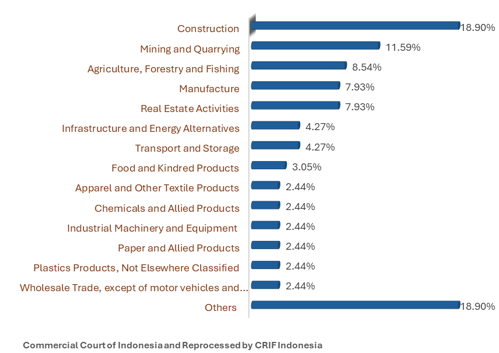
This far exceeds mining (11.59%), agriculture (8.54%), manufacturing (7.93%), and real estate (7.93%). The surge in PKPU cases stems from milestone-based payment structures, prolonged cash conversion cycles, and high leverage. External shocks such as material price fluctuations and La Niña-driven weather disruptions further amplify financial stress. Notably, major state-owned contractors like Waskita Karya and Wijaya Karya faced multiple PKPU filings in 2023–2024, underscoring systemic liquidity vulnerabilities even among large players.
Based on CRIF Indonesia’s data compiled from the Commercial Court of Indonesia, the construction sector recorded the highest number of PKPU (debt restructuring) and bankruptcy cases in Q3 2025, with 31 cases representing 18.90% of all filings. This figure far exceeds other sectors such as mining and quarrying at 11.59%, agriculture at 8.54%, manufacturing at 7.93%, and real estate at 7.93%, highlighting that liquidity risk in construction is structural and more severe than in other industries. The primary driver of this vulnerability is the sector’s reliance on government projects with milestone-based payment structures. When budget disbursements are delayed or project execution slows, cash inflows collapse, leaving receivables outstanding and obligations to suppliers unmet. CRIF’s financial analysis reinforces this fragility: Accounts Receivable Turnover stands at 0.222, Days Sales Outstanding reaches 1,645 days, equivalent to more than 4.5 years and the Debt-to-Equity Ratio is 2.45, signaling heavy leverage and prolonged cash conversion cycles. These conditions create significant liquidity stress and elevate the probability of default.
External factors further exacerbate the situation. Volatility in material prices and import policy shifts inflate costs under fixed-price contracts, while climate risks such as La Niña-driven extreme rainfall disrupt timelines and increase downtime expenses. These dynamics explain why even large state-owned contractors like Waskita Karya and Wijaya Karya faced multiple PKPU filings in 2023–2024, proving that liquidity fragility is systemic and not confined to smaller players. The implications are clear: despite a positive outlook for 2026 with projected real growth of around 5% and nominal growth near 8%, driven by post-disaster reconstruction in Sumatra, credit risk remains high if left unaddressed.
To mitigate these risks, companies must implement aggressive strategies including accelerating receivables collection through segmentation and automated reminders, strengthening contract governance with progress billing clauses and penalties for delays, reducing leverage via refinancing and ESG-linked financing, and adopting prefabrication and modular construction to minimize weather-related downtime and improve cash conversion cycles. CRIF classifies the sector’s credit risk as very high, given the structural nature of liquidity constraints and leverage exposure. Without decisive intervention, PKPU cases may persist despite macroeconomic recovery. Conversely, firms that enforce robust financial governance and operational resilience can transform these challenges into a competitive advantage, positioning themselves to capture reconstruction-driven demand while maintaining solvency.
2026 Construction Outlook: Post-Disaster Recovery and Growth Amid Climate Risks
The outlook for 2026 remains positive, with real growth projected at around 5% and inflation near 3%, translating into nominal growth of approximately 8%. CRIF outlines three scenarios: a baseline at 8% (IDR 2,588 trillion), an upside at 8.5% (IDR 2,600 trillion) if Sumatra’s reconstruction accelerates, and a downside at 7% (IDR 2,564 trillion) if La Niña and budget absorption delays hinder progress. The government’s infrastructure allocation of IDR 118.5 trillion for roads, bridges, and irrigation under the 2026 state budget provides a strong foundation for sectoral resilience.
Severe flooding, landslides, and galodo in Sumatra during November–December 2025 created a significant reconstruction impulse. Damage to over 140 bridges and 150,000 homes has triggered urgent demand for disaster-resilient housing, slope protection, river normalization, and access restoration. The government has mobilized a dedicated task force, initiated construction of 2,000 housing units, and allocated recovery funding estimated at USD 3 billion. This reconstruction wave is expected to strengthen subsectors such as roads and bridges, water and irrigation systems, and housing throughout 2026.
Climate risk remains a critical factor. BMKG forecasts a weak La Niña persisting into early 2026, increasing rainfall intensity and the likelihood of project delays in the first half of the year. CRIF recommends proactive measures including front-loaded contract awards, ready-to-execute designs, prefabricated and modular construction methods, and climate-proofing strategies such as hydraulic modeling and slope stabilization. Effective government spending will also be essential to maintain contractor cash flow and ensure timely project delivery.
From a credit and financing perspective, cash flow visibility improves in 2026 due to government-backed projects and reconstruction programs, though risks of delayed disbursement and scope changes must be managed through structured tenors. Exposure to selective IKN projects should be balanced with disaster recovery and water resilience initiatives. The cement market, which contracted 2.5% in 2025, is expected to recover moderately in 2026, supported by housing renovation and reconstruction demand. Securing framework agreements for materials and adopting green cement solutions will enhance cost efficiency and align with ESG financing trends. Overall, Indonesia’s construction sector is on a strong recovery path, with regional opportunities in Sumatra and strategic imperatives to manage climate, fiscal, and supply chain risks effectively.