The third quarter of 2025 marked a period of significant turbulence for Indonesian businesses. Amid global uncertainty triggered by U.S. protectionist policies, China’s economic slowdown, and geopolitical tensions in the Middle East, Indonesia’s economy still recorded positive growth of 5.04% year-on-year, according to the Central Statistics Agency (BPS). However, behind this growth, liquidity pressures and rising operational costs drove a surge in cases of Suspension of Debt Payment Obligations (PKPU).
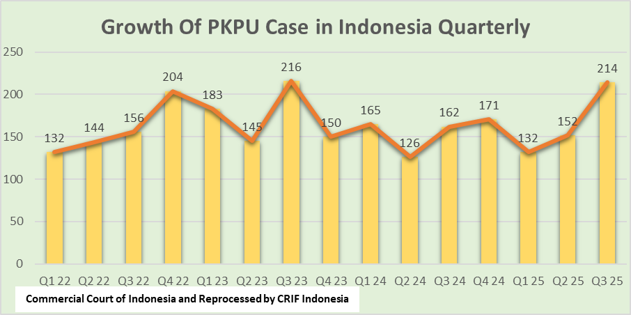
Data from the Case Tracking Information System (SIPP) shows that PKPU cases rose sharply to 214 cases in Q3 2025, up from 152 cases in the previous quarter. This surge highlights mounting financial pressure experienced by businesses, particularly in capital-intensive industries. The majority of cases (approximately 86%) involved suspension of debt payment obligations, with the remainder being bankruptcy petitions.
After declining in 2024, PKPU cases have been rising again since early 2025, with a notable acceleration in the third quarter. This trend reveals intensifying financial strain, even as the broader economy grows. In other words, growth is uneven, and many companies are struggling to maintain healthy cash flows.
These dynamics underscore a paradox: positive macroeconomic growth does not necessarily reflect corporate financial health. External factors, protectionism, global slowdown, and geopolitical risks, have amplified cost pressures, prompting many companies to choose PKPU as a debt restructuring mechanism.
Further SIPP data for Q3 2025 shows 214 registered cases, comprising 184 cases of Bankruptcy and Suspension of Obligations for Payment of Debt and 30 Petition for Declaration of Bankruptcy. This composition confirms that PKPU remains the dominant mechanism for addressing corporate financial distress. PKPU serves as an “early intervention” tool to manage debt risks before firms become insolvent, indicating that many businesses still have opportunities to restructure through formal legal processes and negotiation.
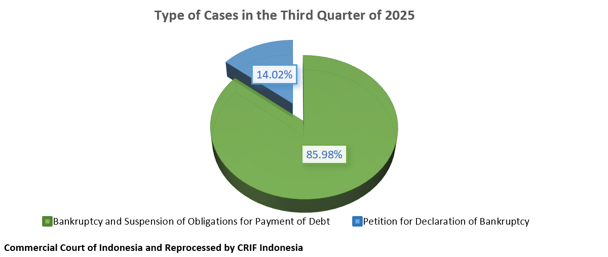
The relatively small proportion of bankruptcy petitions (around 14% or one out of six cases), compared to the dominance of PKPU (86%), signals that creditor–debtor relations in Indonesia remain fairly constructive. This suggests that most companies still have prospects for continued operations, provided they are given room for negotiation and debt restructuring. From a macroeconomic perspective, this indicates that financial pressures have not yet translated into widespread permanent bankruptcies.
Monthly Trends in PKPU Cases (Oct 2024 – Sep 2025)
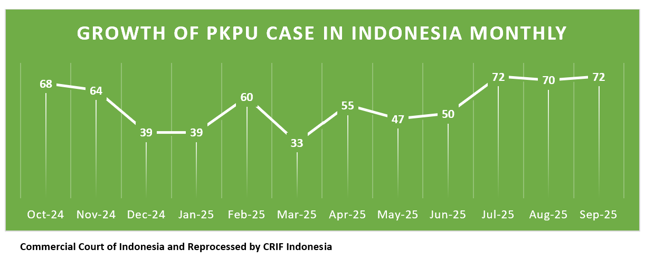
The chart shows monthly PKPU case trends from October 2024 to September 2025. Although the pattern is somewhat volatile, a sharp spike appears in Q3 (July–September 2025), with 72 cases in July, 70 in August, and 72 in September, the highest levels in the period. This highlights Q3 as the most critical phase for businesses.
The Q3 surge reflects worsening liquidity. Key contributing factors include:
- Higher Operational Costs: Rising global energy prices due to Middle Eastern geopolitical tensions, and a weakening rupiah caused by global uncertainty.
- Weaker Export Demand: China’s slowdown and U.S. protectionism pressured manufacturing and commodity sectors.
- Corporate Financial Cycles: Q3 often coincides with major payment obligations (loans, taxes, installments), prompting financially stressed companies to choose PKPU as a breathing space.
Regional Distribution of PKPU Cases (Oct 2024 – Sep 2025)
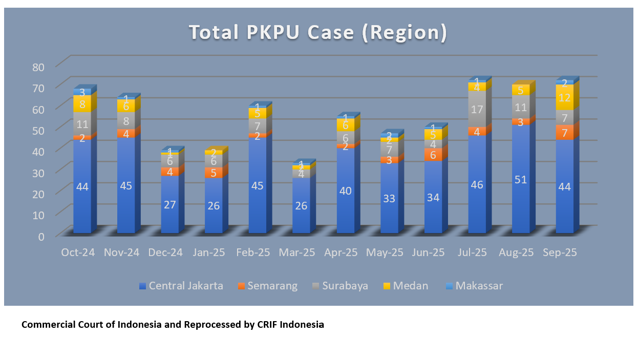
Data across five major regions, Central Jakarta, Semarang, Surabaya, Medan, and Makassar, shows fluctuating PKPU cases.
- Jakarta leads every month, peaking at 51 cases in August 2025 and remaining high in September (44 cases). This dominance reflects the capital’s complex business ecosystem, trade, property, and financial services, sectors highly sensitive to domestic and global volatility. Liquidity pressure was amplified during the government transition period in Q3, prompting companies to prioritize restructuring over expansion.
- Surabaya ranks second, with a stable upward trend in July–August (17 cases in July, 11 in August). As a major international trade gateway, Surabaya is affected by export slowdowns and rising logistics costs, particularly impacting shipping and manufacturing sectors reliant on imported materials.
- Semarang shows fluctuating cases with peaks in August (11 cases) and September (12 cases). As an industrial and distribution hub in Central Java, Semarang faces increased transport costs and weakening domestic demand, leading companies to resort to PKPU for business continuity.
- Medan records fewer cases but remains notable, especially in August (7 cases). As a commodity hub, Medan’s pressure stems from China’s reduced demand and CPO price volatility, making companies vulnerable to cash flow disruptions.
- Makassar has the lowest and most stable figures throughout the period (6 cases in October 2024 and 7 in September 2025). This suggests that Makassar’s business structure is more defensive and less exposed to global market fluctuations, though still burdened by distribution costs.
PKPU by Business Line
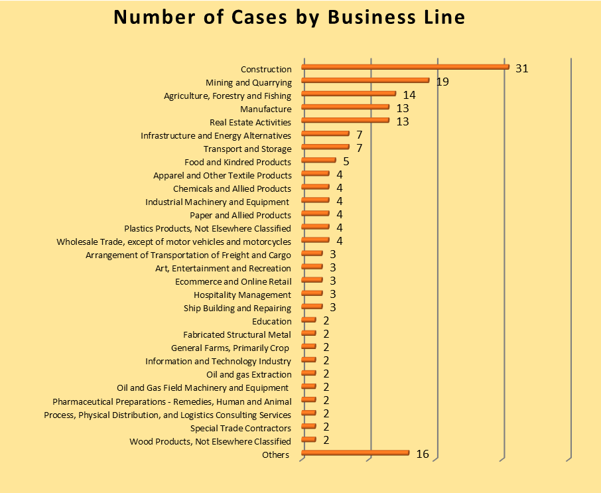
Construction dominates with 31 cases, followed by Mining and Quarrying (19 cases), Agriculture/Forestry/Fishing (14), and both Manufacturing and Real Estate (13 each). Other sectors show smaller but still meaningful numbers.
- Construction: Dominance reflects liquidity risks in long-term, capital-heavy projects. Global uncertainty, rising material prices, and currency fluctuations inflated project costs. Infrastructure delays during the government transition in Q3 exacerbated the situation, driving many firms into PKPU for restructuring.
- Mining and Quarrying: With 19 cases, this sector suffers from China’s economic slowdown, volatile energy prices influenced by Middle Eastern conflicts, and heavy dependence on exports.
- Agriculture, Forestry, Fishing: The 14 cases highlight vulnerability to climate impacts and global food price swings. A weaker rupiah increases fertilizer and equipment costs, squeezing margins.
- Manufacturing & Real Estate:
- Manufacturing faces global protectionism and rising costs of imported materials.
- Real estate suffers from political uncertainty and relatively high interest rates, slowing property development and sales.
Other sectors, transportation, energy infrastructure, chemicals, also display stress tied to logistics costs, energy prices, and weakening industrial demand.
PKPU in the Manufacturing Sector (Q3 2025)
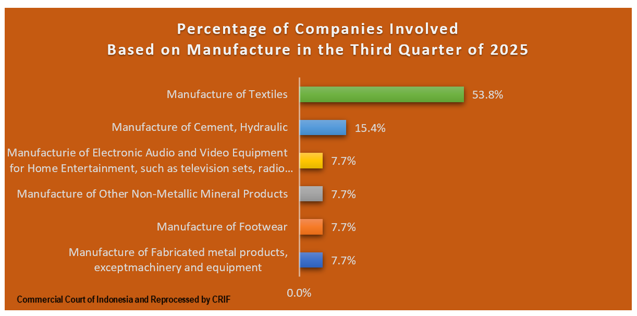
- Manufacture of Textiles dominates with 53.8%, far outpacing other subsectors.
- Manufacture of Cement, Hydraulic follows with 15.4%.
- Four subsectors, audio-video electronics, non-metal mineral products, footwear, and fabricated metal products, each contribute 7.7%.
The dominance of textiles indicates severe pressure on this export-oriented, labor-intensive sector. China’s slowdown and U.S. protectionism reduced export volumes, while the weaker rupiah pushed up imported raw material costs. Competition from Vietnam and Bangladesh further shrank margins, pushing many textile firms toward PKPU to survive.
The cement subsector’s 15.4% share aligns with declining construction and infrastructure projects during the 2025 government transition, coupled with higher energy prices that inflate production costs.
Other subsectors, electronics, non-metal minerals, footwear, metals, face pressures from declining global demand, rising input prices, and reduced construction activities.
What is the Future Outlook for PKPU?
Entering Q4 2025, Indonesian businesses stand at a crossroads between optimism and caution. After peaking in Q3, liquidity stress remains substantial. Dominant sectors, construction, manufacturing, textiles, have not fully recovered.
However, seasonal factors may slow the rise in PKPU filings. Toward year-end, companies often strive to maintain attractive financial statements for investors and creditors, typically leading to slightly fewer PKPU submissions.
On the policy front, if the government begins implementing pro-business fiscal measures, such as liquidity incentives or accelerated infrastructure spending, the pressure may ease.
Projection:
Q4 is likely to record still-elevated PKPU figures, though slightly lower than Q3, estimated at 180–190 cases, with capital-intensive and export-oriented sectors remaining dominant.
PKPU Outlook for 2026
Based on current trends and external pressures, 2026 could unfold in three possible scenarios:
Optimistic Scenario
If the government stabilizes fiscal policy, accelerates infrastructure projects, and diversifies export markets, PKPU cases could gradually decline. Previously strained companies may recover, bringing PKPU numbers back to normal levels: 120–150 cases per quarter.
Moderate Scenario
If global uncertainties persist, U.S. protectionism, Chinese slowdown, elevated energy prices, and domestic policies are only partially effective, PKPU filings will remain high, though not as severe as in 2025: 160–180 cases per quarter.
Pessimistic Scenario
If U.S. protectionism worsens (higher tariffs), geopolitical conflict increases energy costs further, and the rupiah weakens sharply, financial pressures could intensify. Manufacturing (particularly textiles and footwear) and construction would face renewed crisis conditions. PKPU cases may return to, or exceed, the highs seen in Q3 2025.